
How to Check If iPhone Fold Is Original: Authenticity Guide
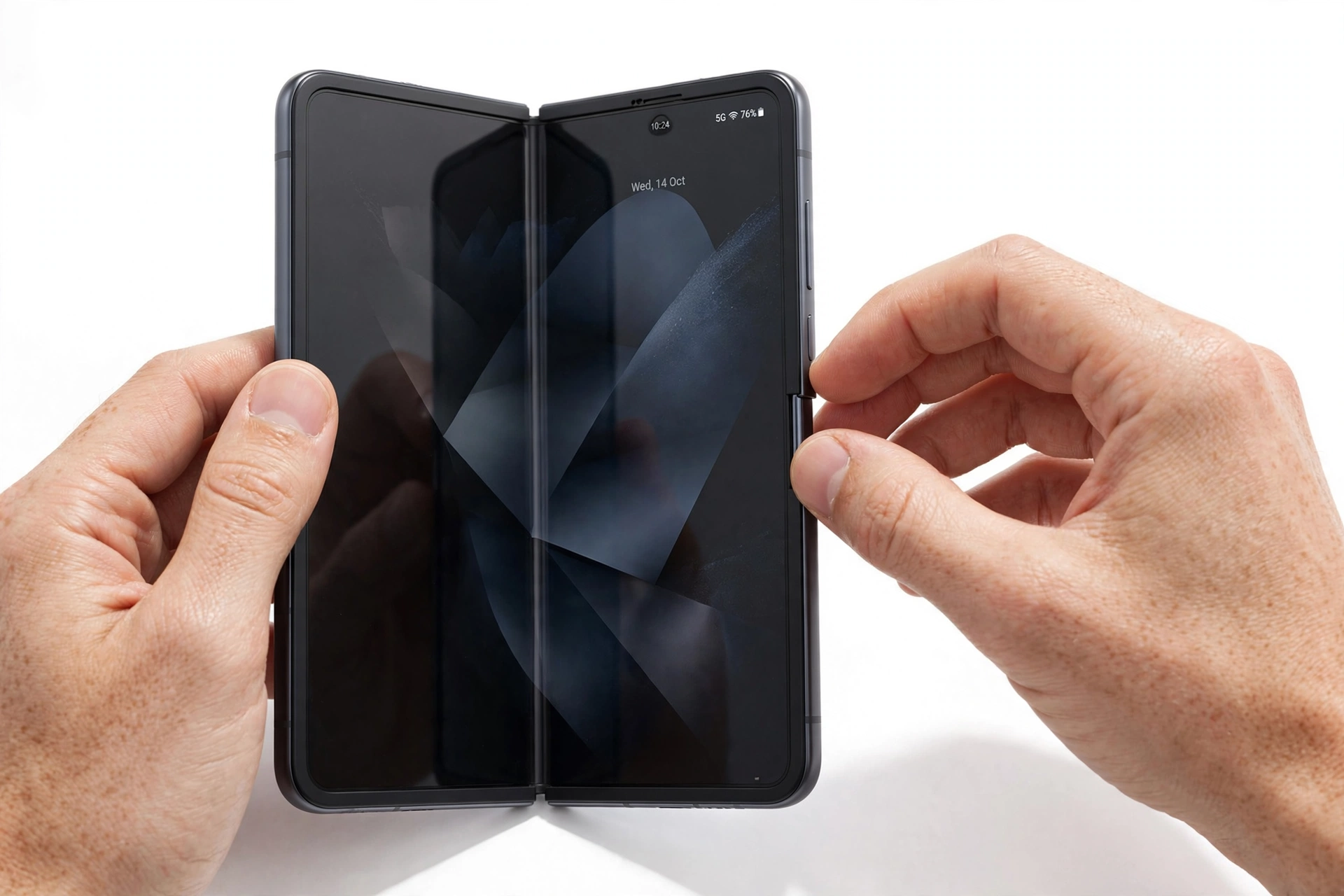
There is no product called “iPhone Fold”: any device sold under that name fails the existence test. Apple’s first foldable, announced September 9, 2026 per reporting, is officially named iPhone Duo — and as of this writing it is still in its pre-order window, so an “iPhone Fold” in a seller’s hands today cannot be genuine Apple hardware.
On this page
There is no product called “iPhone Fold”: any device sold under that name fails the existence test.
1. The name test is your first and strongest check
Counterfeit sellers and rumor-era listings have spent years using “iPhone Fold” as the placeholder name for Apple’s foldable iPhone. Rumor coverage settled on names like “iPhone Fold” and “iPhone Ultra” long before the product existed. When Apple finally introduced the device at its September 2026 event, it chose a different name entirely: iPhone Duo — a name reporting says was deliberately selected to distance the device from the “Fold” and “Ultra” branding used by Samsung and Chinese rivals. (Source: macrumors.com)
This gives you an immediate, decisive filter. A genuine Apple foldable will never identify itself as an “iPhone Fold” anywhere: not on the box, not in Settings > General > About, not in the model name, not on Apple’s coverage-check page. The name “iPhone Fold” exists only in rumor articles, concept videos, and fraudulent listings. If a seller is offering you an “iPhone Fold,” the name itself is the first red flag.
Quick fact: Apple reportedly rejected both “Fold” and “Ultra” as product names for its foldable before settling on “Duo,” according to launch-event reporting. A listing that still uses “iPhone Fold” is working from pre-launch rumor knowledge, not from holding the actual device.
2. What Apple actually launched: the reported iPhone Duo baseline
Before you can judge whether a device is genuine, you need a baseline for what the genuine device is. Everything in this section is reported from launch-event coverage (MacRumors, 9to5Mac, TechCrunch, Macworld, TechRepublic), not from Apple specifications I measured directly, and I cite those outlets in the sources section. No prices, dates, or specs below are invented; where reporting sources disagree or leave details unconfirmed, I say so.
Per launch reporting, the iPhone Duo is Apple’s first foldable iPhone, unveiled September 9, 2026, at Apple’s “Surprise and shine” event — the first major product launch led by Apple’s new CEO, John Ternus, following Tim Cook’s transition. It is a book-style foldable: a 5.4-inch outer display that unfolds to reveal a 7.6-inch inner display. Both displays are Super Retina XDR OLED with ProMotion up to 120Hz, Always-On, and up to 3,000 nits of peak outdoor brightness. Both share the same aspect ratio, so content scales rather than reshapes when the phone unfolds.
The reported specification baseline is:
- Displays: 7.6-inch inner (1,878 × 2,670 pixels) and 5.4-inch outer (1,398 × 2,034 pixels), both Super Retina XDR OLED with ProMotion
- Chip: A20 Pro (built on a 2nm process), the same chip reported in the iPhone 18 Pro and Pro Max
- Authentication: Touch ID integrated into the side button — notably, no Face ID
- Cameras: dual 48MP rear system (Fusion Main + Fusion Ultra Wide), 12MP Center Stage front camera on the outer display, and an under-display FaceTime camera on the inner panel
- Body: grade 5 titanium frame, 5.2mm thick when unfolded, 11.3mm folded, 254 grams — the heaviest iPhone to date per reporting
- Water resistance: IP68 for dust and water resistance
- Crease control: custom nano-texture finish on the inner display intended to minimize crease visibility and reduce glare
- SIM: eSIM-only, like the previous year’s iPhone Air
- Storage: 256GB, 512GB, 1TB, or 2TB
- Colors: Star White and Night Sky (a dark blue)
- Battery: dual batteries — up to 44 hours of video on the outer display, 31 hours on the inner display per Apple
- Software: iOS 27, adapted for the foldable form factor with Split View, dual-window app instances, and an expanded StandBy mode
- Price: starting at $1,999 for the 256GB model per reporting
- Connectivity: in-house C2 cellular modem, Wi-Fi 7, Bluetooth 6, second-generation Ultra Wideband
3. Why timing is your second decisive check
Here is a timing fact that does most of your detective work for you: according to every launch report, the iPhone Duo was announced September 9, 2026, opened pre-orders on October 16, 2026, and goes on sale in stores on October 23, 2026, in more than 70 countries and regions (a further 28 countries follow on October 30). As of this guide’s last source check (October 14, 2026), the device is still in its pre-order window — it is not yet on sale at retail anywhere.
This makes the timing test brutally simple:
- Any physical “foldable iPhone” sold before October 16, 2026 cannot have come from Apple’s supply chain, because Apple had not shipped a single retail unit.
- Any device in a seller’s hands today (mid-October 2026) is at best a pre-order allocation — and a seller with warehouse stock, review units, or “excess inventory” is claiming access to something Apple itself has not yet released.
- Any listing showing a different launch date — for example, claiming the foldable launched alongside the iPhone 18 Pro on September 18/19 — contradicts the reported retail timeline, since reporting consistently places the Duo’s sale date five weeks after the 18 Pro models.
- “iPhone Fold” review units do not exist. Review coverage used the official name, iPhone Duo.
Stop for safety: never send a deposit or pre-payment for a device that has not been released. With the iPhone Duo still in its pre-order window, any request for a deposit on an “iPhone Fold” is fraud by definition — the product being named does not exist, and the real product is not yet for sale.
4. Signature lie detectors: the details a counterfeit cannot get right
Genuine devices carry a cluster of specific, verifiable traits that cheap counterfeits consistently fail. These are the signature checks for the iPhone Duo era:
4a. Touch ID in the side button — not Face ID
Per every launch report, the iPhone Duo uses Touch ID integrated into the side button rather than Face ID — the first iPhone in years to return to fingerprint authentication, reportedly because Face ID’s sensor array could not fit the folded form factor. This is the single strongest lie detector. A counterfeit “foldable iPhone” that shows a Face ID enrollment screen, or that claims Face ID on a foldable, contradicts the reported hardware: the real device has no Face ID hardware at all. On a genuine Duo you enroll fingerprints in Settings, not faces. (Reporting also notes the device can be unlocked with an Apple Watch as an alternative.)
4b. The nano-texture inner display
Apple’s reported approach to the foldable crease is a custom nano-texture finish on the inner panel, meant to minimize crease visibility and cut glare. A counterfeit with an obviously ridged, glossy crease down the middle — the look of early Samsung and Motorola foldables — fails the finish test. No counterfeit to date replicates Apple’s reported nano-texture process.
4c. Dual 48MP camera EXIF test
The reported rear system is a dual 48MP setup (Fusion Main + Fusion Ultra Wide) with optical-quality 2x zoom and macro. A full-resolution 48MP iPhone photo measures approximately 8,064 × 6,048 pixels. If a seller claims a device has 48MP cameras but its photos are smaller than this, the camera claim is false. Cheap counterfeits typically have 8–16MP sensors interpolated in software; the EXIF dimensions expose them.
4d. The dimensions and weight
Reported measurements are precise and unusual: 5.2mm thick when unfolded, 11.3mm when folded, and 254 grams — described as the thinnest yet heaviest iPhone. A counterfeit will almost never match all three. A kitchen scale and a ruler are legitimate test tools here.
4e. eSIM-only — no physical SIM tray
Reporting states the iPhone Duo is eSIM-only, like the previous year’s iPhone Air. Any foldable device that accepts a physical nano-SIM card and claims to be an iPhone Duo or “iPhone Fold” fails instantly: the real device has no SIM tray.
5. The 10-check authenticity worksheet
Work through these checks in order. A single fail on checks 1–4 ends the examination; the rest build confidence.
| # | Check | Genuine result | Fail |
|---|---|---|---|
| 1 | Product name on box and in Settings | “iPhone Duo” — never “iPhone Fold” | Any “iPhone Fold” branding |
| 2 | Availability timing | Pre-ordered after Oct 16, 2026; retail after Oct 23, 2026 | Device existed before Oct 16, 2026 |
| 3 | Biometric authentication type | Touch ID in side button; no Face ID | Face ID enrollment offered |
| 4 | SIM type | eSIM-only; no physical SIM tray | Physical SIM tray present |
| 5 | Apple coverage check (checkcoverage.apple.com) | Valid serial returns an iPhone Duo | “Unable to verify” or wrong model |
| 6 | Inner display finish | Nano-texture, minimal crease visibility | Obvious ridged glossy crease |
| 7 | Photo resolution (rear main) | 48MP ≈ 8,064 × 6,048 px | Smaller dimensions |
| 8 | Thickness and weight | 5.2mm open, 11.3mm closed, 254g | Meaningfully different measurements |
| 9 | Colors | Star White or Night Sky only | Colors Apple never sold |
| 10 | Operating system | iOS 27 with foldable Split View | Skinned Android underneath |
6. Software identity: the checks a fake cannot survive
Physical copies are getting better; software identity is where most counterfeits collapse. Work through these in order:
- Apple’s coverage page. Go to checkcoverage.apple.com and enter the serial number (Settings > General > About, or on the original box). A genuine iPhone Duo serial returns a valid coverage record showing the correct model. Counterfeits fail here in three ways: the serial is invalid (“we’re unable to verify”), the serial is a copied genuine number from a different iPhone model, or the seller refuses to provide it before purchase. Note: a valid serial alone is not proof — cloned serials exist — but an invalid one is decisive.
- Settings > General > About. A genuine device shows “iPhone Duo” as the model name, a capacity of 256GB, 512GB, 1TB, or 2TB, and iOS 27. Android-based counterfeits run a skinned launcher that mimics iOS but cannot pass this screen: the “capacity” often shows odd values, and tapping through to the App Store reveals Google’s Play Store underneath.
- iOS 27 foldable features. The reported Duo-specific software includes Split View with two apps or two windows of one app, saved app pairs, pinning videos to half the display, and an expanded StandBy mode across both screens. A device running generic Android cannot reproduce these. Apple Pencil support (USB-C model) was reported to arrive later in the year — its absence now is not a fail.
- The under-display FaceTime camera. The inner display reportedly houses an under-display FaceTime camera for an all-screen feel, plus a 12MP Center Stage front camera on the outer display. A counterfeit with a conventional punch-hole or notch on the inner panel contradicts the reported design.
- Sign-in behavior. A genuine device signs into an Apple Account and reaches the real App Store. A counterfeit typically opens a fake storefront. Never sign into your real Apple Account on a device you suspect is counterfeit — clone firmware is a credential-harvesting risk.
Stop for safety: never enter your Apple Account password, payment details, or any personal credentials on a device whose authenticity is in doubt. If the device is counterfeit, its software may log everything you type. Verify first; sign in only on a confirmed-genuine device.
7. The four listing patterns sellers actually use
Counterfeit and gray-market listings for a high-profile launch device follow predictable patterns. Recognizing the pattern tells you what kind of fraud you are looking at.
| Pattern | What the listing says | How to test it |
|---|---|---|
| 1. The rumor-name listing | “Brand new iPhone Fold, factory sealed” | The product name is the fail: Apple never used “iPhone Fold.” Ask for the serial and run it on checkcoverage.apple.com. |
| 2. The pre-release warehouse claim | “Excess stock,” “review units,” or “early shipment” before Oct 23, 2026 | Timing is the fail: Apple had not shipped retail units before Oct 23, 2026. There is no excess stock to have. |
| 3. The relabeled Android foldable | Shows a real foldable (often a Samsung or Chinese-brand device) re-skinned to look like iOS | Check Settings > About, photo EXIF dimensions, and whether the App Store is really Apple’s. Android skins cannot fake the coverage page. |
| 4. The deposit / pre-order scam | “Reserve your iPhone Fold with a deposit” or “guaranteed launch-day unit” | No product named “iPhone Fold” exists to reserve; the real iPhone Duo is sold through Apple and authorized retailers. Any deposit request is fraud. |
8. Model numbers and capacities: what the genuine lineup allows
Per launch reporting, the iPhone Duo ships in four storage configurations — 256GB, 512GB, 1TB, and 2TB — and two colors, Star White and Night Sky. Any listing offering a different capacity (128GB, 3TB) or a different color (gold, purple, “midnight green”) contradicts the reported lineup. Model numbers for the Duo were not published in the reporting I reviewed as of the last source check; I do not invent them here. If you are comparing a seller’s claimed model number against Apple’s records, use the serial-number lookup on checkcoverage.apple.com rather than trusting a number printed on a box — boxes are trivially reprinted.
Quick fact: the reported starting price is $1,999 for the 256GB model, with the highest-capacity model reported around $3,000. A “new” foldable iPhone offered far below $1,999 is not a bargain — it is either counterfeit, a different device, or a scam that ships nothing.
9. Purchase-channel risk: where fakes concentrate
| Channel | Risk level | Why |
|---|---|---|
| Apple Store / apple.com | Lowest | Apple sells only genuine iPhone Duo; serial verifiable at purchase |
| Authorized carriers and retailers | Low | Authorized stock comes through Apple’s channel; still verify the serial |
| Established marketplaces with buyer protection | Medium | Counterfeit “iPhone Fold” listings concentrate here; use the worksheet and never skip the coverage check |
| Social media / messaging-app sellers | High | No buyer protection, no returns; the deposit-scam pattern is common |
| Sellers who refuse serial checks or in-person inspection | Highest | A genuine seller has no reason to refuse verification |
10. What these checks can and cannot establish
Honesty about the limits of your own examination keeps you from drawing the wrong conclusion.
| Observation | Establishes | Does not establish |
|---|---|---|
| Name reads “iPhone Fold” | The device is not a genuine Apple product | — |
| Valid serial on checkcoverage.apple.com | The serial is a real Apple serial | That the physical device matches the serial (cloned serials exist) |
| Matches reported specs exactly | High confidence it is genuine | Apple warranty status or that the internals are unmodified |
| Invalid serial | The device is not genuine Apple hardware | — |
| Seller refuses verification | Elevated fraud risk | That the device is definitely fake (some sellers are merely careless) |
11. Hypothetical examples: how the scams actually play out
The following are hypothetical illustrations, not customer stories.
Amara’s marketplace “iPhone Fold.” Amara finds a listing for a “brand new iPhone Fold, factory sealed” at $1,400 — well under the reported $1,999 starting price of the real device. She asks the seller for the serial number so she can check it on Apple’s coverage page. The seller says the serial is “inside the sealed box” and offers to open it after payment. Two checks already fail: the product name (Apple never sold an “iPhone Fold”) and the price (far below the reported starting price of the genuine iPhone Duo). Amara walks away. Had she proceeded, check 5 of the worksheet — the coverage lookup — would almost certainly have failed or revealed a different model.
Devon’s deposit trap. Devon wants the foldable on launch day and finds a seller offering “guaranteed October 23 iPhone Fold units” for a $500 deposit. The seller claims to have a warehouse allocation. Devon notes three problems: the product is called the wrong name, Apple sells the real iPhone Duo through its own channels with pre-orders opening October 16 (no third party can “guarantee” launch-day stock), and the device is not yet for sale at all. He reports the listing instead of sending money. Since no product named “iPhone Fold” exists and the real device was not yet retailing, the deposit would have been unrecoverable.
12. When to stop and get help
Stop the examination and seek professional help when:
- You have already paid for a device that fails checks 1–5 of the worksheet — dispute the charge with your payment provider immediately rather than continuing to troubleshoot the device.
- The seller becomes evasive, threatening, or pressures you to complete the deal quickly.
- You suspect you entered personal credentials into a counterfeit device — change your Apple Account password from a trusted device and review your account’s signed-in devices.
- You are buying in person and the seller will not allow serial verification or inspection before payment.
If you have already purchased a device and need an in-person assessment, a reputable repair shop can inspect the hardware against the reported iPhone Duo baseline. For readers in the Las Vegas area, Las Vegas Phone Repair & Accessories (7400 Las Vegas Blvd S, Unit TT42, Las Vegas, NV 89123; (424) 406-6202) offers in-person assessments — call ahead to confirm today’s hours. This is an assessment service, not a guarantee of a particular outcome; no shop can certify a device as genuine from photos alone.
13. Frequently asked questions
Is there really no product called “iPhone Fold”?
Correct. Per launch-event reporting, Apple named its first foldable iPhone Duo, announced September 9, 2026. “iPhone Fold” was a rumor-era placeholder name used by media and leakers before the launch; Apple never used it for the product. Any device sold under the name “iPhone Fold” is not genuine Apple hardware. For background on verifying other iPhone models, see our guide on how to check if an iPhone is refurbished.
When can I actually buy the real iPhone Duo?
Per reporting: pre-orders opened October 16, 2026, with retail availability from October 23, 2026, in more than 70 countries and regions (28 more on October 30). As of this guide’s last source check (October 14, 2026), the device is still in its pre-order window and not yet on sale at retail. Anyone selling you one before those dates is not selling Apple hardware.
Why does the iPhone Duo use Touch ID instead of Face ID?
Per launch reporting, the Duo integrates Touch ID into the side button and omits Face ID — reportedly because the Face ID sensor array could not fit the folded form factor. This is also your strongest authentication tell: a foldable iPhone that offers Face ID enrollment contradicts the reported hardware.
Can I verify a foldable iPhone with Apple’s website?
Yes — enter the serial number at checkcoverage.apple.com. A genuine iPhone Duo serial returns a valid coverage record for the correct model. This is the single most authoritative remote check. Combine it with the physical checks in the worksheet, since serial numbers can be cloned.
What does a genuine iPhone Duo cost?
Reporting puts the starting price at $1,999 for the 256GB model, with higher capacities reported up to around $3,000. Treat any “new” foldable iPhone priced far below $1,999 as a counterfeit indicator, not a deal.
Does the real iPhone Duo have a visible crease?
Per reporting, Apple applied a custom nano-texture finish to the inner display specifically to minimize crease visibility and reduce glare — trading away a little contrast for a near-seamless look. A device with a deeply ridged, glossy crease down the middle does not match the reported finish.
I bought an “iPhone Fold” and now suspect it’s fake. What should I do?
First, do not sign into your Apple Account or enter payment details on it. Run the worksheet checks, especially the coverage-page serial lookup. If it fails, dispute the charge with your payment provider promptly — time limits apply. If you entered credentials, change your Apple Account password from a trusted device. An in-person hardware assessment can document what the device actually is.
How is the iPhone Duo different from the iPhone 18 Pro?
Per reporting, the Duo shares the A20 Pro chip and dual-48MP rear cameras with the iPhone 18 Pro line (see our iPhone 18 Pro authenticity guide), but adds the folding form factor: a 7.6-inch inner and 5.4-inch outer display, Touch ID instead of Face ID, eSIM-only design, dual batteries, and iOS 27’s foldable multitasking. It is also far more expensive, starting at a reported $1,999.
Video: How to check if an iPhone is original
Sources and editorial notes
- MacRumors — iPhone Duo Launching This Month With These 15 New Features (October 9, 2026): reported feature summary — 7.6-inch inner / 5.4-inch outer displays, nano-texture, Touch ID in side button, dual 48MP cameras, A20 Pro, pre-orders October 16, on sale October 23.
- Digit.in — Apple iPhone Duo: reported unveiling at the September 9, 2026 “Surprise and shine” event, “Duo” name chosen over “Fold”/”Ultra,” A20 Pro, Touch ID, iOS 27, 70+ countries from October 23.
- Macworld — iPhone Duo Guide: Release date, price, specs and features: reported pre-order and retail dates, 256GB–2TB storage, titanium design, IP68, initial-supply caution.
- TechRepublic — iPhone Duo Cheat Sheet: Price, Specs, Features: reported $1,999 starting price, display resolutions, Touch ID, 44-hour outer-display battery, Star White and Night Sky colors.
- Digital Trends — iPhone Duo: Everything you should know: reported name confirmation settling “iPhone Fold”/”iPhone Ultra” speculation, September 9 event details.
- 9to5Mac — iPhone Duo reportedly not named Ultra: pre-launch reporting on the “Duo” name, $1,999 price, white and dark blue colors.
- TechCrunch — Apple unveils its first foldable, the iPhone Duo: reported nano-texture crease approach, grade 5 hinge materials, eSIM-only, dual batteries.
- MacRumors — iPhone Duo roundup: reported dimensions (5.2mm open, 11.3mm closed, 254g), grade 5 titanium frame, IP68, display aspect-ratio behavior.
- Apple Support — Check your Apple warranty / coverage status: Apple’s official serial-number coverage lookup (checkcoverage.apple.com) — the authoritative remote verification path referenced in this guide.
Last source check: October 14, 2026. AI-assisted editorial guide, checked against the linked manufacturer and reporting sources. Launch details (name, dates, specifications, pricing) are reported from third-party launch coverage, not from Apple press materials reviewed directly, and are framed accordingly. If Apple publishes corrected specifications, the official guidance takes precedence. This guide is for identification purposes and does not guarantee any device’s authenticity from photos or descriptions alone.
Let’s get you connected again.
Tell us what’s happening with your device and we’ll help you decide the safest next step — no jargon, no pressure.
Las Vegas Phone Repair & Accessories · 7400 Las Vegas Blvd S, Unit TT42, Las Vegas, NV 89123
10:00 AM–8:00 PM — call ahead to confirm today’s hours