
How to Check If iPhone 18 Pro Max Is Original: Authenticity Guide
You can verify an iPhone 18 Pro Max by checking its serial number at Apple’s coverage lookup, testing its variable-aperture camera, and cross-matching the IMEI. The 18 Pro Max launched in September 2026 with a signature feature no counterfeit can reproduce: a 48MP main camera with a mechanically variable aperture — and any “18 Pro Max” that fails that test, or carries a specification Apple never shipped, is not genuine.
On this page
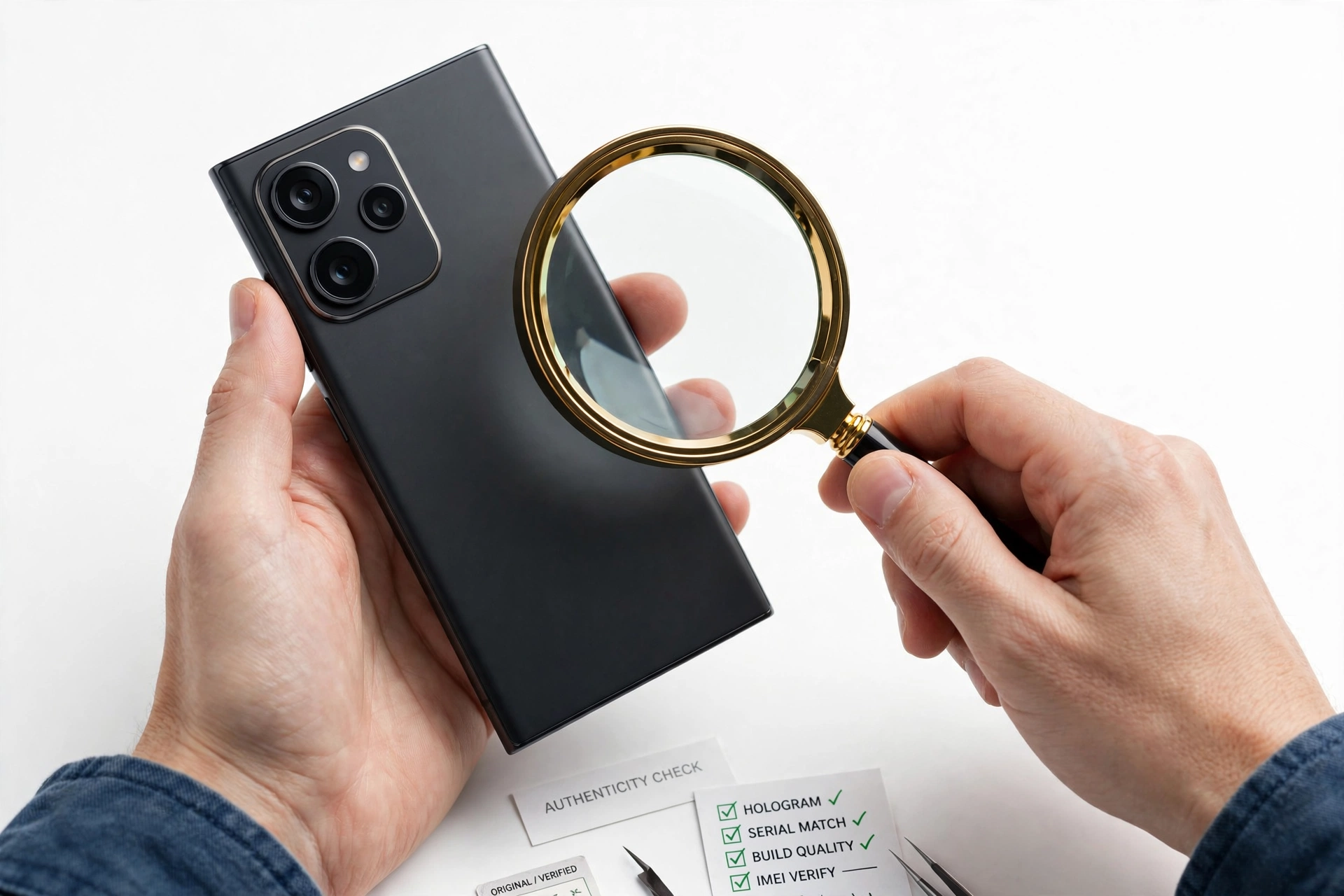
You can verify an iPhone 18 Pro Max by checking its serial number at Apple’s coverage lookup, testing its variable-aperture camera, and cross-matching the IMEI.
1. The 60-second existence test
Before you run any technical check, answer one question: does the device you are looking at describe something that exists? (Source: apple.com)
Unlike some heavily rumored devices that never materialize, the iPhone 18 Pro Max is a real, launched product. Apple announced it on September 9, 2026, alongside the smaller iPhone 18 Pro, and it went on sale on September 18, 2026. That means the existence test here is not about whether Apple made an 18 Pro Max — it is about whether the specific unit in front of you matches what Apple actually shipped.
This distinction matters because the most common “fake 18 Pro Max” is not a crude knockoff. It is a genuine older iPhone — usually an iPhone 17 Pro Max — that has been relabeled, reboxed, or misrepresented as the newer model. Such a phone will pass a casual glance: it is an iPhone, it has three cameras, it feels premium. Only the specific checks below separate it from the real thing.
Quick fact: Apple’s launch coverage confirms the 18 Pro and 18 Pro Max share nearly everything — the A20 Pro chip, the camera system, the four colors, the charging speed. The differences between the two are exactly four: screen size, physical dimensions and weight, battery ratings, and price. If a seller claims the Pro Max has a camera or chip advantage over the 18 Pro, that claim itself is a red flag.
2. Why the 18 Pro Max is harder to fake convincingly than it looks
Every iPhone generation has a “signature tell” — a hardware feature that is difficult or impossible for counterfeiters to reproduce. For the iPhone 18 Pro generation, that tell is the variable-aperture main camera.
Every previous iPhone had a fixed aperture: the main lens opened to exactly one f-stop, always. The 18 Pro Max’s 48MP Fusion Main camera has four mechanical aperture settings — ƒ/1.48, ƒ/1.8, ƒ/2.8, and ƒ/4.0 — selectable in the Camera app’s Pro controls. Moving aperture blades inside a phone lens is a precision-mechanical achievement. A counterfeit cannot replicate it, and a relabeled iPhone 17 Pro Max (whose main camera is fixed at one aperture) cannot produce it in software.
This single check is the fastest way to collapse the entire question. Everything else in this guide corroborates it, but the aperture test is the lie detector.
3. The reported launch specification baseline
To judge whether a phone is genuine, you need a reference. The table below summarizes the iPhone 18 Pro Max’s reported launch specifications, drawn from Apple’s announcement coverage and third-party spec reporting. Every figure is presented as reported, not as a laboratory-verified measurement by this guide.
| Attribute | Reported specification | Why it matters for fakes |
|---|---|---|
| Announced | September 9, 2026 | Any “18 Pro Max” sold before this date was a scam |
| On sale | September 18, 2026 | Same — pre-launch units did not exist |
| Display | 6.9-inch Super Retina XDR OLED, 2868 × 1320, 460 ppi, ProMotion 120Hz | Wrong resolution or refresh rate = reject |
| Chip | A20 Pro (2nm) | Benchmarks must match this generation |
| Memory | 12GB RAM (reported) | Less RAM reported by system info = suspect |
| Main camera | 48MP Fusion, variable aperture ƒ/1.48–ƒ/4.0 | The signature tell — see section 4 |
| Ultra Wide | 48MP Fusion | 12MP ultra wide = older model |
| Telephoto | 48MP Fusion, 4x optical | 12MP 5x telephoto = iPhone 16 Pro Max, not 18 |
| Front camera | 18MP Center Stage | 12MP front = older generation |
| Dynamic Island | Smaller, supports 3 simultaneous Live Activities | Large old-style island = relabeled older phone |
| Storage | 256GB, 512GB, 1TB, 2TB | 128GB “Pro Max” = instant reject |
| Colors | Black, Silver, Glacier, Burgundy | Any other color name = reject |
| Body | Aluminum unibody, Ceramic Shield 2 front | Titanium frame = iPhone 16 Pro Max |
| Weight | 249 g | Significantly lighter = different device |
| Dimensions | 163.4 × 78.0 × 8.75 mm | Mismatched dimensions = reject |
| Software | iOS 27 | Cannot run older iOS at launch; much newer iOS on “new” sealed unit = suspicious |
| U.S. starting price | $1,299 (256GB, reported) | Wildly lower “new” prices = scam pricing |
| Charging | 50% in ~15 minutes wired (reported) | Slow charging claims = mislabeled older model |
| Video playback | Up to 45 hours (eSIM model, Apple-rated) | 33-hour rating = iPhone 16 Pro Max figure |
Keep this table open as you work through the checks. A genuine 18 Pro Max matches every row. A relabeled older iPhone will fail several rows at once — and one failure is enough to stop.
4. Check 1: The variable-aperture camera test (the signature lie detector)
This is the single most decisive check. Open the Camera app on the phone, switch to the main (1x) camera, and look for Pro controls or aperture settings. On a genuine iPhone 18 Pro Max, you can select between four aperture values: ƒ/1.48, ƒ/1.8, ƒ/2.8, and ƒ/4.0.
To make the test rigorous, do this:
- Point the main camera at a scene with both near and far subjects.
- Set the aperture to ƒ/1.48 and take a photo. Note the background blur.
- Set the aperture to ƒ/4.0 and take the same photo again.
- Compare the two images. On a genuine unit, the ƒ/4.0 shot has visibly more of the scene in focus — because a real mechanical iris changed the light path.
A relabeled iPhone 17 Pro Max cannot do this. Its lens has one fixed aperture, so any “aperture” control in its camera software is either absent or purely digital blur simulation — and digital portrait blur looks different from a true aperture change. A counterfeit running skinned Android will typically show a fake camera UI that either crashes when you change the setting or produces two identical images.
Stop for safety: If the phone you are examining gets unusually hot during this test, or the Camera app crashes repeatedly, stop. Overheating can indicate a counterfeit battery or modified hardware. Do not continue testing a device that behaves dangerously — set it aside and do not charge it.
5. Check 2: Settings → General → About
On the phone itself, go to Settings → General → About. This screen shows the model name, model number, serial number, and capacity as the operating system reports them.
What to verify:
- Model Name should read “iPhone 18 Pro Max.” If it says iPhone 17 Pro Max, iPhone 16 Pro Max, or anything else, the device is not what the seller claims — regardless of the box it came in.
- Capacity must be one of 256GB, 512GB, 1TB, or 2TB. A 128GB “18 Pro Max” does not exist and never did.
- Model Number begins with a letter indicating the sales region (for example, region codes differ between U.S., European, and Asian units). An unfamiliar or malformed model number deserves a closer look.
A sophisticated counterfeit can spoof this screen, so never treat it as conclusive on its own. But a failure here is conclusive in the other direction: if the phone itself says it is a 17 Pro Max, no box, sticker, or seller story overrides that.
6. Check 3: Apple’s coverage lookup (serial number verification)
Apple’s official coverage check at checkcoverage.apple.com lets you enter a serial number and see what Apple has on file for that device — model, purchase-date validation status, and warranty state.
- Find the serial number in Settings → General → About (or on the original box, though the on-device value is the one that counts).
- Enter it at checkcoverage.apple.com.
- Confirm the model Apple returns is “iPhone 18 Pro Max.”
Two honest caveats. First, a cloned serial number is a known counterfeit technique: a fake phone can display a serial number copied from a genuine unit, in which case Apple’s lookup returns the genuine device’s record. That is why the serial check must be combined with the hardware checks above — a cloned serial passes the website but fails the aperture test. Second, if Apple’s lookup returns a different model than the phone claims to be, believe Apple: the unit is misrepresented.
Quick fact: Apple also offers a parts-and-service-history view in Settings → General → About on recent iOS versions, showing whether the display or battery has been replaced and whether the parts are genuine Apple parts. On a brand-new sealed 18 Pro Max this section should show no replacements. Entries here on a “new” phone mean it was opened or repaired — which contradicts a sealed-new claim. For more on reading those labels, see our guide on how to check if an iPhone is refurbished, new, or a replacement unit.
7. Check 4: The *#06# IMEI triple cross-match
Open the Phone app and dial *#06#. The IMEI (or IMEIs, on dual-SIM configurations) will appear on screen. Now compare that number against three places:
- The IMEI shown by *#06# on screen.
- The IMEI in Settings → General → About.
- The IMEI printed on the SIM tray (on models that have one) or on the original box.
All three must match. A mismatch between the on-screen IMEI and the box IMEI is a classic sign of a reboxed phone — a genuine older iPhone placed in a printed 18 Pro Max box. A mismatch between *#06# and Settings suggests modified firmware.
Note that some regional 18 Pro Max units are eSIM-only with no physical SIM tray; in that case the tray check does not apply, and that absence is normal — not a defect and not evidence of fakery. Know which configuration your region sells before treating a missing tray as suspicious.
8. Check 5: Physical inspection — the details counterfeits get wrong
Hold the phone and inspect it deliberately. Check these in order:
- Size and weight. The 18 Pro Max is 163.4 × 78.0 × 8.75 mm and 249 g. It should feel substantial. A phone that feels light or measures wrong is a different device.
- Frame material. The 18 Pro generation uses an aluminum unibody. If the frame looks and feels like the titanium of the iPhone 16 Pro Max generation — different color, different texture — you are likely holding a 16 Pro Max.
- Camera plateau. The 18 Pro models have a redesigned full-width camera plateau. Compare against official product images: the lens arrangement, the LiDAR placement, and the plateau’s shape should match exactly.
- Dynamic Island. The 18 Pro generation has a visibly smaller Dynamic Island than the 17 generation. Side by side with product photos, an old-size island is obvious.
- Color. Only four finishes exist: Black, Silver, Glacier, and Burgundy. Burgundy is the new color for this generation and the hardest for counterfeiters to match accurately — compare it against Apple’s official images, not the seller’s photos.
- Buttons and ports. The Action button, Camera Control, and USB-C port should all be present and precisely machined. Loose buttons, misaligned ports, or a missing Camera Control indicate a fake or a much older device.
- Display quality. Power on the screen and look at text closely. A genuine Super Retina XDR panel at 460 ppi renders text razor-sharp. A counterfeit panel often shows visible pixelation or washed-out colors at an angle.
9. Check 6: The Dynamic Island three-activity test
The 18 Pro generation’s smaller Dynamic Island can display up to three Live Activities simultaneously — a software-hardware integration detail that is difficult to fake.
To test it: start three Live Activities at once (for example, a timer, music playback, and a navigation session or sports score). On a genuine 18 Pro Max, the island expands to show all three in a stacked layout. A relabeled iPhone 17 Pro Max, with its larger older island and older layout logic, will not reproduce this exact behavior. A counterfeit running a skinned OS will typically show a crude imitation or fail to stack the third activity.
10. Check 7: Performance and modem sanity checks
The A20 Pro is a 2nm chip, and the 18 Pro Max is reported to carry 12GB of RAM. Two quick software checks corroborate the hardware:
- Benchmark. Run a reputable benchmark app and compare the score against published 18 Pro Max results. A relabeled 17 Pro Max (A19 Pro) scores measurably lower; a counterfeit with a mid-range Android chip scores dramatically lower. Treat benchmark numbers as corroborating evidence, not a verdict on their own.
- Cellular behavior. The 18 Pro Max uses Apple’s C2 modem on non-U.S. models. In the field test mode or network settings, the modem firmware identifiers should be consistent with a 2026 Apple modem, not a Qualcomm or MediaTek part. This is a secondary check — useful when combined with the others.
| # | Check | Genuine result | Fail means |
|---|---|---|---|
| 1 | Variable aperture test | Four selectable apertures; ƒ/1.48 vs ƒ/4.0 visibly differ | Not a genuine 18 Pro generation camera |
| 2 | Settings → About model name | “iPhone 18 Pro Max” | Misrepresented device |
| 3 | Capacity | 256GB / 512GB / 1TB / 2TB | 128GB = does not exist |
| 4 | checkcoverage.apple.com | Returns “iPhone 18 Pro Max” | Serial belongs to a different model |
| 5 | *#06# triple cross-match | Screen, Settings, and box all match | Reboxed or modified firmware |
| 6 | Physical: 249 g, aluminum unibody | Matches published dimensions | Different device |
| 7 | Dynamic Island 3-activity test | Three Live Activities stack correctly | Older model or counterfeit OS |
| 8 | Color | Black, Silver, Glacier, or Burgundy | Any other finish = reject |
| 9 | Benchmark vs published results | Matches A20 Pro class | Older chip or non-Apple silicon |
| 10 | Box and documentation | IMEI/serial match device; print quality perfect | Reboxed unit |
11. The most common scam: the relabeled iPhone 17 Pro Max
Based on how previous iPhone launches have played out, the most likely “fake 18 Pro Max” you will encounter is a genuine iPhone 17 Pro Max being sold as an 18 Pro Max — sometimes in a counterfeit box, sometimes simply misdescribed in a listing. Here is how the two compare on the points that matter:
| Attribute | iPhone 17 Pro Max (reported) | iPhone 18 Pro Max (reported) | The tell |
|---|---|---|---|
| Chip | A19 Pro | A20 Pro (2nm) | Benchmark gap; About screen |
| Main camera aperture | Fixed | Variable ƒ/1.48–ƒ/4.0 | The aperture test — decisive |
| Dynamic Island | Larger, older design | Smaller, 3 Live Activities | Visible size difference |
| Frame | Aluminum unibody (17 gen) | Aluminum unibody, new plateau | Camera plateau shape differs |
| Front camera | Older TrueDepth | 18MP Center Stage | Spec sheet mismatch |
| Colors | 17-generation finishes | Black, Silver, Glacier, Burgundy | Burgundy only exists on 18 Pro |
| Charging | Slower wired charging | 50% in ~15 min (reported) | Charging-speed test |
The aperture test and the Dynamic Island test each catch this scam independently. A seller offering a “brand new 18 Pro Max” at a price far below the $1,299 reported starting price, especially in a marketplace listing with stock photos, fits this pattern precisely.
(The following is a hypothetical illustration, not a customer story.) Amara finds an “iPhone 18 Pro Max 512GB” on a marketplace for $850 — nearly $650 below the reported retail price for that storage tier. The listing uses official Apple product renders. She meets the seller, runs the aperture test, and finds no aperture control in the Camera app; Settings → About reads “iPhone 17 Pro Max.” The phone is genuine Apple hardware — just last year’s model in this year’s story. She walks away.
12. The impossible-configuration filter
Some fakes can be rejected without touching the phone, from the listing alone. If any of these appear, the listing is fraudulent:
| Claimed configuration | Why it is impossible |
|---|---|
| 128GB iPhone 18 Pro Max | Storage starts at 256GB; no 128GB tier exists |
| Any color other than Black, Silver, Glacier, Burgundy | Only four finishes were launched |
| Titanium frame | 18 Pro generation uses aluminum unibody; titanium was the 16 Pro generation |
| 5x telephoto camera | The 18 Pro Max telephoto is 4x; 5x was the 16 Pro Max |
| 12MP front camera | The 18 Pro Max front camera is 18MP Center Stage |
| Ships with iOS 26 or earlier | Launched with iOS 27; cannot run older iOS |
| “18 Pro Max” sold before September 18, 2026 | No retail units existed before the on-sale date |
| Physical Touch ID button | No iPhone 18 model has Touch ID |
13. Where you buy changes the risk
| Channel | Risk level | Notes |
|---|---|---|
| Apple Store / apple.com | Minimal | Direct from Apple; serial registered at purchase |
| Authorized carrier stores | Low | Carrier inventory is Apple-supplied; keep the receipt |
| Major retailers (sealed) | Low | Verify the seal and run the About-screen checks before leaving |
| Established refurbishers with warranty | Moderate | Should disclose exact model; verify with the checks above |
| Marketplace / classifieds (in person) | High | Run every check in this guide before paying; meet in a safe public place |
| Marketplace (shipped, no inspection) | Very high | No opportunity to test; highest relabeling risk |
| Street vendors / no receipt | Severe | No recourse; assume misrepresentation until proven otherwise |
14. The five categories of “not genuine”
Not every non-genuine 18 Pro Max is the same kind of problem. Understanding which category you are dealing with determines what to do next:
| Category | What it is | How to spot it | What to do |
|---|---|---|---|
| Relabeled genuine iPhone | A real 17 or 16 Pro Max sold as an 18 Pro Max | About screen, aperture test, Dynamic Island | Do not pay the 18 Pro Max price; report the listing |
| Counterfeit hardware | Non-Apple phone in an iPhone-like body | Display quality, benchmark, camera behavior | Do not buy; do not sign in to any account on it |
| Reboxed unit | Genuine phone, wrong box (IMEI mismatch) | *#06# triple cross-match | Verify the phone itself; box adds no value |
| Stolen / Activation Locked | Genuine 18 Pro Max tied to someone else’s Apple Account | Activation Lock screen on setup | Do not buy — it can never be activated by you |
| Bait listing | No phone exists; listing harvests deposits or data | Refuses in-person inspection, demands wire transfer | Disengage; report the listing |
Stop for safety: Never sign in with your Apple Account on a phone you suspect is counterfeit. Fake devices can run modified software designed to harvest credentials. Complete every authenticity check as a signed-out guest before entering any personal account, payment, or identity information. If the device is Activation Locked to someone else’s account, there is no legitimate bypass — walk away.
15. What these checks can and cannot establish
Honesty about the limits of verification is part of verification. This table states what each layer of checking actually proves:
| Check | Can establish | Cannot establish |
|---|---|---|
| Existence / spec filter | Whether the claimed configuration was ever sold | Whether this specific unit is genuine |
| Variable aperture test | Whether the camera hardware is 18 Pro generation | Whether the phone was stolen |
| checkcoverage.apple.com | What model Apple associates with the serial | Whether the serial was cloned onto a fake |
| *#06# cross-match | Whether phone, Settings, and box agree | Whether the box is original Apple packaging |
| Physical inspection | Whether dimensions, materials, and finish match | Internal component originality |
| Benchmark | Whether performance matches the A20 Pro class | That the chip is literally an A20 Pro |
| Purchase channel | The level of recourse if something is wrong | Authenticity by itself |
No single check is sufficient. The aperture test plus the serial lookup plus the About screen, taken together, make a wrong answer extremely unlikely — but “extremely unlikely” is the honest ceiling, not absolute certainty.
16. What to do if the phone fails a check
If any check fails, stop the transaction. Do not let the seller explain away a failed aperture test or a mismatched serial — these are hardware and database facts, not matters of opinion.
If you already paid:
- Document everything. Photograph the phone, the box, the listing, and your messages with the seller. Screenshot the About screen and the failed check.
- Do not attempt to “fix” a counterfeit. Do not open it, do not try to flash firmware, and do not charge it if it behaves abnormally.
- Dispute promptly. If you paid through a platform with buyer protection, file the claim immediately — most platforms have deadlines measured in days.
- Report the listing. Marketplace fraud reporting helps the next buyer.
- For in-person assessments in Las Vegas, a reputable shop can examine the device and document its findings. Las Vegas Phone Repair & Accessories, 7400 Las Vegas Blvd S, Unit TT42, Las Vegas, NV 89123, (424) 406-6202, can assess a device you already own — call ahead to confirm today’s hours. An assessment documents what the device is; it does not convert a fake into a genuine phone.
(The following is a hypothetical illustration, not a customer story.) Devon pays a deposit for a “sealed 18 Pro Max” from an online seller who refuses video calls. The box arrives with a slightly blurry Apple logo and the *#06# IMEI does not match the box. Devon photographs everything, files a platform dispute the same day with the mismatch documented, and recovers the payment. The seller’s account is removed a week later.
17. Frequently asked questions
Can I verify an iPhone 18 Pro Max without opening the box?
Partially. You can check the box’s printed IMEI and serial against Apple’s coverage lookup, and inspect the seal and print quality. But the decisive checks — the aperture test, the About screen, the Dynamic Island test — require powering on the device. For a high-value purchase, insist on opening and testing before money changes hands. A seller who refuses this is telling you something.
Does the iPhone 18 Pro Max have a SIM tray?
It depends on the region. U.S. models in recent generations have been eSIM-only with no physical SIM tray, while many international models retain one. Know which configuration your market sells: a missing tray on a U.S. unit is normal, while a missing tray on a unit sold as an international dual-SIM model is suspicious. Match the configuration to the region the seller claims.
How is the 18 Pro Max different from the 18 Pro for authenticity purposes?
Almost not at all — and that is useful. Apple’s own spec sheet differs between the two on only four lines: display size, physical size and weight, battery ratings, and price. Everything else, including the variable-aperture camera that serves as the signature authenticity tell, is identical. Any check in our iPhone 18 Pro authenticity guide applies equally to the Pro Max; just use the Pro Max’s 6.9-inch, 249 g figures where size matters. Our broader iPhone 18 authenticity guide covers the split-launch context that makes the standard iPhone 18 a different case entirely.
Can a software update turn an iPhone 17 Pro Max into an 18 Pro Max?
No. The differences are hardware: the variable-aperture lens assembly, the A20 Pro chip, the smaller Dynamic Island, the 18MP Center Stage front camera. No software update installs new camera hardware. A phone that “became” an 18 Pro Max after an update is a 17 Pro Max with modified system information — the hardware checks in this guide will still expose it.
What does it mean if checkcoverage.apple.com shows a different purchase date than the seller claims?
It means at least one of the two is wrong. Apple’s record reflects when the serial was first activated or registered. A “brand new sealed” phone showing a year-old activation date was activated before — it is not new, whatever the shrink wrap suggests. Resealed boxes are a known technique; trust the database over the packaging.
Are Burgundy units more likely to be fake?
Burgundy is the new color for the 18 Pro generation, so it draws extra attention from counterfeiters — but a genuine Burgundy 18 Pro Max is also simply a popular choice. Judge the phone by the checks in this guide, not by the color. That said, compare the Burgundy finish carefully against Apple’s official product images: counterfeit anodization often misses the exact hue or shows uneven coating under bright light.
Should I worry about the modem difference between U.S. and international models?
Only as a consistency check. Reported coverage indicates non-U.S. 18 Pro Max units use Apple’s C2 modem while U.S. models use a different cellular configuration. What matters for authenticity is internal consistency: the model number’s region code, the SIM configuration, and the modem behavior should all point to the same region. A “U.S. model” with a dual physical SIM tray is inconsistent — that combination was never sold.
When should I stop checking and get a professional assessment?
Stop and seek help when checks disagree with each other (for example, the serial lookup says 18 Pro Max but the aperture test fails), when the device behaves dangerously (overheating, swelling, strange odors), or when significant money is at stake and you want documented findings for a dispute. Do not open the phone yourself — modern iPhones use glued assemblies and the battery is a fire risk if punctured. An assessment examines the device without unsafe disassembly.
Video: How to check if an iPhone is original
Sources and editorial notes
- Apple Newsroom: Apple debuts iPhone 18 Pro and iPhone 18 Pro Max — Apple’s September 9, 2026 announcement; launch dates, four finishes, variable-aperture camera, A20 Pro, iOS 27, pricing. Summarized in original language.
- TechRepublic: iPhone 18 Pro cheat sheet — Side-by-side 18 Pro vs 18 Pro Max specifications including display resolutions, storage tiers, battery ratings, weights, and colors. Summarized in original language.
- The Mac Observer: iPhone 18 Pro vs Pro Max spec-sheet differences — Apple’s spec sheet differs on exactly four lines (display, dimensions/weight, battery, price); all other rows identical. Summarized in original language.
- 9to5Mac: iPhone 18 Pro pre-order coverage — Pre-order and availability timeline, A20 Pro performance claims, charging speed, Dynamic Island details. Summarized in original language.
- LatestTechUpdates: 18 Pro Max vs 16 Pro Max comparison — Generation-over-generation differences (titanium to aluminum, 5x to 4x telephoto, 33- to 45-hour video playback). Summarized in original language.
- Apple: Check Coverage (checkcoverage.apple.com) — Apple’s official serial-number coverage lookup referenced for Check 3. Official tool; usage described from Apple’s own documentation.
Last source check: October 14, 2026. AI-assisted editorial guide, checked against the linked manufacturer information. Launch specifications are presented as reported by Apple and press coverage, not as independently laboratory-verified measurements. If Apple revises specifications or new information emerges, the baseline table should be re-verified before use in a purchase decision.
Let’s get you connected again.
Tell us what’s happening with your device and we’ll help you decide the safest next step — no jargon, no pressure.
Las Vegas Phone Repair & Accessories · 7400 Las Vegas Blvd S, Unit TT42, Las Vegas, NV 89123
10:00 AM–8:00 PM — call ahead to confirm today’s hours