
How to Check If iPhone 18 Is Original: Authenticity Guide
As of October 2026, a standard iPhone 18 does not exist — so any “iPhone 18” (non-Pro) offered for sale right now is almost certainly mislabeled or counterfeit. This guide explains the split launch, the reported expectations for the real standard model, and the checks that separate a genuine iPhone from a fake.
On this page
As of October 2026, a standard iPhone 18 does not exist — so any “iPhone 18” (non-Pro) offered for sale right now is almost certainly mislabeled or counterfeit.
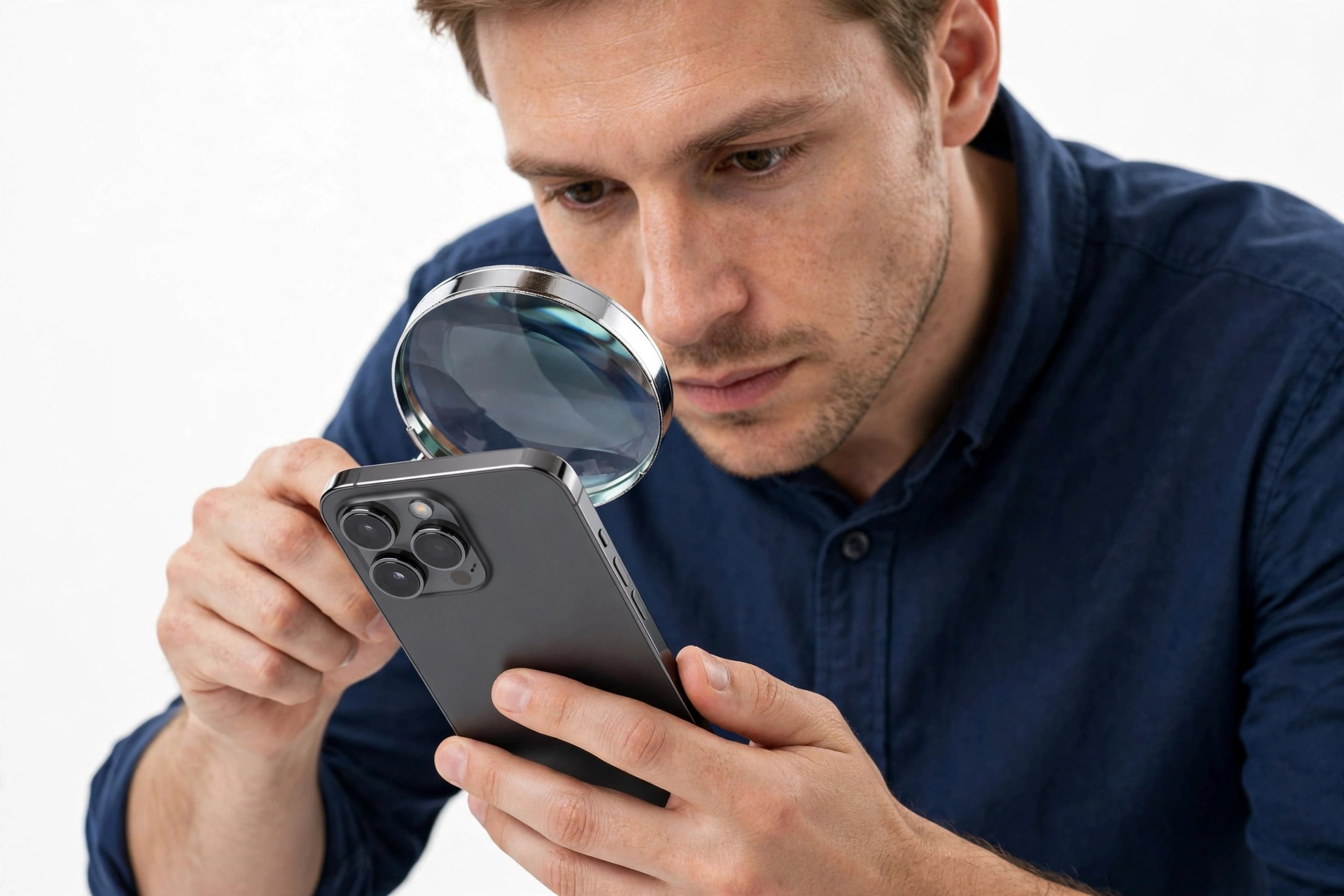
1. The fastest authenticity check: the standard iPhone 18 has not launched
Before you check serial numbers or inspect packaging, you need to know the calendar — because it settles the question for most listings you will encounter. (Source: macrumors.com)
At Apple’s September 2026 event, Apple launched three premium models: the iPhone 18 Pro, the iPhone 18 Pro Max, and the iPhone Duo (Apple’s first foldable iPhone). There was no standard iPhone 18 at that event, and Apple has not announced one since.
Multiple press reports describe a split launch strategy: the premium models (18 Pro, 18 Pro Max, iPhone Duo) shipped in fall 2026, while the standard iPhone 18, the iPhone 18e, and a second-generation iPhone Air are reportedly scheduled for spring 2027 — likely March or April. The iPhone 17 remains Apple’s current mainstream non-Pro iPhone in the meantime.
Quick fact: If someone is selling you a standard “iPhone 18” today — new, sealed, or refurbished — treat it as fake or mislabeled until proven otherwise. No legitimate unit of the standard model should be in anyone’s hands before its reported spring 2027 window.
This also means any listing that shows a standard “iPhone 18” at a price, with specs, or with a launch date in 2026 is describing something that contradicts public reporting. That single observation is more decisive than any serial-number check, because serial numbers can be copied while a calendar cannot.
2. Who this guide is for
This guide is written for someone who has found a listing, an offer, or a gifted phone described as an “iPhone 18” (standard, non-Pro) and wants to know whether it is genuine. You might be:
- Shopping secondhand or on a marketplace and seeing “iPhone 18” listings far below expected pricing.
- Wondering whether to wait for the real standard model or buy something else now.
- Checking a phone someone handed you — a gift, a trade, a bulk-lot purchase — that claims to be the newest iPhone.
If you are actually looking at an iPhone 18 Pro or iPhone 18 Pro Max, those are real, launched products — the checks in this guide still apply, but the launch-timeline fast fail does not. For general refurbished-iPhone questions, see our guide on how to check if an iPhone is refurbished, and for the previous generation, our iPhone 17 authenticity guide.
3. What the real iPhone 18 lineup looks like (reported)
To recognize a fake, you need a baseline of what is real — and what is only reported. Everything about the launched Pro models comes from launch coverage; everything about the standard model is still reported/rumored and must be treated that way.
The launched models: iPhone 18 Pro and iPhone 18 Pro Max
These are genuine, shipping products. Key reported specifications from launch coverage:
- Chip: A20 Pro, built on a 2-nanometer process, with 12GB of RAM.
- Cameras: Three 48MP rear cameras (Fusion main with variable aperture, ultra-wide, telephoto); 18MP front camera.
- Displays: 6.3-inch (Pro) and 6.9-inch (Pro Max) Super Retina XDR OLED with ProMotion.
- Storage: 256GB, 512GB, 1TB, and 2TB options.
- Prices: From $1,199 (Pro) and $1,299 (Pro Max) in the US — $100 higher than their iPhone 17 Pro predecessors, which Apple attributed to higher memory costs.
- Colors: Black, Silver, Glacier, and Burgundy.
- Software: Ships with iOS 27.
- US models: Dual eSIM — no physical SIM tray on US units (continuing the pattern Apple set with the iPhone 14).
- Dynamic Island: Reportedly smaller than previous generations.
The standard iPhone 18: reported expectations, not confirmed facts
The standard model is not yet announced. The following expectations come from press reporting and rumors — they are useful as a sanity filter, not as a verification checklist:
- Reported window: Spring 2027, likely March or April.
- Reported display: 6.3 inches.
- Reported chip: A20 (non-Pro), also expected on 2-nanometer.
- Reported price: Around $899 (rumored, unconfirmed).
- Reported cameras: Two 48MP rear cameras expected (not the Pro’s triple system).
- Dynamic Island: Possibly smaller, per rumors.
Because none of this is confirmed, the only thing you can truly check today is the existence test: the standard iPhone 18 has not launched. Anything sold as one right now fails it.
| Model | Status (October 2026) | Reported starting price | Reported chip |
|---|---|---|---|
| iPhone 18 Pro | Launched, shipping since Sept 18, 2026 | $1,199 | A20 Pro |
| iPhone 18 Pro Max | Launched, shipping since Sept 18, 2026 | $1,299 | A20 Pro |
| iPhone Duo (foldable) | Launched Sept 2026, reportedly shipping late Oct 2026 | ~$1,999 (reported) | Reported A20 Pro |
| iPhone 18 (standard) | Not launched — reported spring 2027 | ~$899 (rumored) | A20 (rumored) |
| iPhone 18e | Not launched — reported spring 2027 | ~$699 (rumored) | A20 (rumored) |
| iPhone Air 2 | Not launched — reported spring 2027 | Unconfirmed | Unconfirmed |
4. Impossible configurations: instant rejects
Even before any technical check, these observations should end the conversation. A unit matching any of them is not a genuine standard iPhone 18:
- Being sold as new or sealed today. The standard model has not launched; there is no legitimate retail stock.
- Running anything other than genuine iOS. A real iPhone runs Apple’s iOS — check Settings > General > Software Update. If the phone cannot reach Apple’s update servers, or the settings layout does not match iOS, it is not an iPhone.
- A SIM tray on a US-spec unit. US iPhones have been eSIM-only since the iPhone 14. The standard iPhone 18 is expected to continue this pattern; a SIM tray on a purported US model is a red flag (dual-SIM physical-tray units exist only in specific markets such as China).
- Triple rear cameras labeled “iPhone 18” (non-Pro). The standard model is reported to keep a two-camera system; three 48MP cameras are the Pro signature.
- A price far below the rumored ~$899. Counterfeit units are typically offered at half the expected price or less. Pricing realism is a check, not proof — but extreme discounts are a classic signal.
- Google Play Store instead of the App Store. Genuine iPhones ship only with Apple’s App Store. If you see Google Play, the phone is running Android under an iOS-like skin.
Stop for safety: Never sign in with your Apple ID on a phone you suspect is fake. A counterfeit device can harvest your credentials the moment you type them. Verify the hardware first, on a guest basis, before any account sign-in.
5. The 10 authenticity checks
These checks are ordered from strongest to weakest. No single check is definitive on its own — work through as many as you can.
Check 1 — The calendar test (strongest for the standard model)
Ask: does this exact model exist yet? A standard “iPhone 18” in anyone’s hands before spring 2027 contradicts all public reporting. This check alone disqualifies nearly every current listing.
Check 2 — Serial number on Apple’s coverage page
Go to checkcoverage.apple.com and enter the serial number from Settings > General > About. Apple’s page should return a valid coverage record with the correct model name.
Caveat: serial numbers can be copied from genuine boxes and printed on fakes. A valid serial proves the number exists in Apple’s records — not that the phone in your hand is the one Apple made. Cross-match the serial with the IMEI and the box.
Check 3 — IMEI cross-match
Dial *#06# to display the IMEI, then compare it with the IMEI shown in Settings > General > About and the one printed on the box. All three must agree. A mismatch means at least one element is fabricated.
Apple does not offer a widely documented public IMEI authenticity portal for buyers — the coverage page is serial-based. Treat third-party “IMEI checker” sites as unverified tools, not proof.
Check 4 — Settings > General > About
A genuine iPhone shows a coherent About screen: model name, model number (e.g., region-coded part numbers), serial number, and modem firmware. Tap the model number once — it toggles between the part number and an “A” model number. Counterfeits often show vague or inconsistent values here.
Check 5 — Parts and Service History
On iOS 15.2 and later, Settings > General > About includes a Parts and Service History section showing whether the battery, display, or cameras were replaced with genuine Apple parts. A brand-new sealed “iPhone 18” showing replaced parts — or a phone that lacks this section entirely on a current iOS — deserves scrutiny.
Check 6 — Genuine iOS behavior
This is the check clones fail most often. On the phone:
- Open Settings > General > Software Update. A real iPhone reaches Apple’s servers and reports the genuine iOS version (iOS 27 is current for the 18 generation).
- Open the App Store. It must be Apple’s App Store with Apple ID sign-in — not Google Play or a third-party store.
- Test Siri, iMessage, and FaceTime. Counterfeits cannot activate these Apple services.
- Try AirDrop to a known-genuine iPhone. Android-based fakes cannot complete this.
Check 7 — Apple Intelligence and camera behavior
A genuine 18-generation iPhone supports Apple Intelligence features. More practically: test the cameras against each other. Cover each lens one at a time while switching between the wide, ultra-wide, and (on Pro models) telephoto cameras — each covered lens should black out only its own camera. Clones often have decorative extra lenses.
Check 8 — Physical build and details
Examine the finish: the mute switch/Action button placement, the USB-C port (genuine iPhones charge and transfer data over it), button feel, and display quality. Run the display at full brightness — genuine Super Retina XDR OLED panels have deep blacks and uniform color; fakes often show washed-out LCD panels with visible backlight bleed.
Check 9 — Packaging
Apple’s current boxes are minimal: the phone and a USB-C cable only (no charger, no headphones). Check print quality, regulatory text, and the match between the box’s serial/IMEI and the phone’s. Note that a perfect box proves little — counterfeiters replicate packaging well — so treat this as a weak, supporting check.
Check 10 — Purchase channel
Buy from Apple directly, an Apple Authorized Reseller, or a major carrier. Marketplace and social-media sellers carry the highest risk. See the purchase-channel table below.
| Check | What it proves | Limitations |
|---|---|---|
| 1. Calendar test | The model should not exist in anyone’s hands yet | None for the standard model — decisive |
| 2. Serial on checkcoverage.apple.com | The serial exists in Apple’s records with the right model | Serials can be copied onto fakes |
| 3. IMEI cross-match (*#06# = Settings = box) | Internal consistency of the unit’s identity | Valid IMEI proves the number, not the phone |
| 4. About screen coherence | Firmware reports a plausible Apple identity | Skins can spoof text fields |
| 5. Parts and Service History | Genuine-part service record on current iOS | Only meaningful on real iOS; absent on fakes |
| 6. Genuine iOS behavior | Apple services activate — hardest to fake | Requires network; takes a few minutes |
| 7. Camera/lens test | Hardware matches the claimed camera system | Needs daylight and a few minutes |
| 8. Physical build | Materials and details match Apple quality | Subjective; needs a reference |
| 9. Packaging | Box contents and print match Apple norms | Weak — packaging is easy to copy |
| 10. Purchase channel | Seller accountability | Even good channels have third-party sellers |
6. Fake vs. refurbished vs. mislabeled: know which problem you have
Not every suspicious “iPhone 18” is the same kind of problem, and the remedy differs:
| Category | What it is | What to do |
|---|---|---|
| Counterfeit | Android phone skinned to look like iOS; fake serial/IMEI labels | Do not buy; do not sign in; seek a refund if already purchased |
| Mislabeled Pro | A genuine iPhone 18 Pro sold as a standard “iPhone 18” (or vice versa) | Verify via About screen; price should match the actual model |
| Refurbished sold as new | Genuine iPhone (older model) passed off as the newest | Check Parts and Service History; see our refurbished-check guide |
| Gray-market import | Genuine phone intended for another region (e.g., dual physical SIM for China) | Genuine hardware, but warranty may not apply locally — verify with Apple |
| Scam listing | No phone exists; the listing is a payment or phishing trap | Never pay outside the platform; never share personal details |
A particularly likely scam pattern for the standard iPhone 18: listings that appear before the reported spring 2027 launch, using stolen product renders. These exploit buyers who do not know about the split launch. The calendar test defeats them instantly.
7. Where you buy matters: purchase-channel risk
| Channel | Risk level | Why |
|---|---|---|
| Apple Store / apple.com | Lowest | Direct from Apple; full return and warranty rights |
| Major carriers (at launch) | Low | Authorized; activation records on file |
| Apple Authorized Resellers | Low | Vetted supply chain |
| Large retailers (sealed) | Low–moderate | Good, but watch for marketplace third-party sellers on the same site |
| Secondhand marketplaces | High | No supply-chain guarantee; inspect before paying |
| Social media / messaging apps | Highest | No buyer protection; classic venue for counterfeit and scam listings |
One more consideration specific to this launch: because the standard iPhone 18 is not yet available, no channel can legitimately sell you one today — including otherwise trustworthy retailers. If a reputable-looking site lists a standard “iPhone 18” for pre-order or immediate sale, verify the exact model name carefully; it may be a Pro listing with a truncated title, or a scam page.
8. What each observation can and cannot establish
Honesty matters here. No home check is the same as Apple’s own verification, so keep the limits in mind:
| Observation | Establishes | Does NOT establish |
|---|---|---|
| Serial valid on checkcoverage.apple.com | The serial exists in Apple’s records | That the phone in your hand is the one Apple made |
| IMEI matches across dialer, Settings, box | Internal consistency | That the IMEI was not copied from a genuine unit |
| iMessage/FaceTime activate | Genuine Apple silicon and Apple servers accept the device | That the model name on the box is correct |
| Half-price “new” listing | Strong suspicion of counterfeit or scam | Proof — pricing alone is a signal, not a verdict |
| Calendar: model not yet launched | Any standard “iPhone 18” today is not legitimate stock | Whether a given Pro model is genuine (separate checks) |
9. Hypothetical examples
(The following are hypothetical illustrations, not customer stories.)
Example 1 — Maya’s marketplace “deal.” Maya finds a sealed “iPhone 18, 256GB” for $499 on a classifieds site, months before the reported spring 2027 launch. She asks the seller for the serial number before meeting. The seller refuses and says the box is already wrapped for shipping. Maya walks away: the calendar test already failed, and a seller who will not share a serial number before payment is not worth the risk.
Example 2 — Daniel’s gray-market question. Daniel is offered a genuine-looking iPhone 18 Pro with a physical dual-SIM tray. The serial checks out on Apple’s coverage page and iMessage activates. It is real Apple hardware — but a China-market unit, meaning his local warranty options may be limited. He keeps it only after confirming the warranty implications with Apple, at a price that reflects the trade-off.
10. What to do if the phone is fake
- Do not sign in with your Apple ID, and do not enter payment or banking details. If you already did, change your Apple ID password immediately from a trusted device.
- Do not activate a cellular plan on the device.
- Seek a refund through the platform’s buyer protection, your payment provider, or your credit card issuer. Keep the listing, messages, and receipt.
- Report the seller to the marketplace and, for outright fraud, to local consumer-protection authorities.
- Do not resell a known fake to recover your money — that passes the fraud to someone else.
- Buy the real thing later from an authorized channel once the standard model actually launches.
Tip: If you are unsure and already own the phone, a reputable local shop can inspect the hardware and confirm what you have — but it cannot make a counterfeit genuine, and no shop can activate Apple services on a fake. Las Vegas Phone Repair & Accessories, 7400 Las Vegas Blvd S, Unit TT42, Las Vegas, NV 89123; (424) 406-6202; open 10 AM–8 PM — call ahead to confirm today’s hours.
11. Frequently asked questions
Can I buy a standard iPhone 18 right now?
According to all public reporting, no — the standard iPhone 18 has not launched and is reportedly scheduled for spring 2027. Any unit offered today under that exact name should be treated as mislabeled or counterfeit.
Is the iPhone 18 Pro a real phone I can verify?
Yes. The iPhone 18 Pro and Pro Max launched in September 2026 and are shipping products. The serial-number, IMEI, and iOS checks in this guide apply to them normally — only the calendar fast-fail is specific to the unreleased standard model.
What is the iPhone Duo? Is it the iPhone 18?
The iPhone Duo is Apple’s first foldable iPhone, launched alongside the 18 Pro models in September 2026. It is a separate product line, not the standard iPhone 18. For broader context on the lineup, see our Galaxy S26 authenticity guide for how the same verification principles apply across brands.
Does a valid serial number on Apple’s site prove my iPhone is genuine?
No — it proves the serial exists in Apple’s records. Counterfeiters copy real serials. Combine it with the IMEI cross-match and, most decisively, the genuine-iOS behavior checks (iMessage, FaceTime, App Store, Software Update reaching Apple).
Why is there no physical SIM tray on US iPhones?
Apple moved US iPhones to eSIM-only starting with the iPhone 14. A physical SIM tray on a purported US-spec iPhone 18 is a red flag — though some regions (notably China) still get dual physical SIM models.
What should the box contain?
Apple’s current packaging is minimal: the phone and a USB-C cable. No charger, no headphones. Extra accessories in a “sealed” box are a warning sign.
Can a fake iPhone run the real App Store?
No. Counterfeit iPhones run Android with an iOS-like skin and cannot access Apple’s App Store, iMessage, FaceTime, or Apple servers. If Software Update cannot reach Apple, the phone is not an iPhone.
Should I wait for the standard iPhone 18 or buy an iPhone 17 now?
That is a buying decision, not an authenticity question — but note that the iPhone 17 is Apple’s current mainstream non-Pro model, and waiting means holding out until the reported spring 2027 window. Buy only from authorized channels either way.
Video: How to check if an iPhone is original
Sources and editorial notes
- MacRumors — iPhone 18 roundup: split launch structure; iPhone 18 Pro/Pro Max and iPhone Duo launched September 2026; standard iPhone 18, iPhone 18e, and iPhone Air 2 reportedly coming spring 2027.
- Macworld — iPhone 18 and iPhone 18e: rumored specs table (6.3-inch display, A20 chip, ~$899 expected price, two 48MP cameras); September event came and went without a standard iPhone 18.
- 9to5Mac — iPhone 18 Pro announcement: A20 Pro chip (2nm), variable-aperture 48MP camera, pricing from $1,199/$1,299, pre-orders September 12, launch September 18, 2026.
- The Apple Post — iPhone 18 release date and rumors: standard model widely expected spring 2027; specs remain unconfirmed.
- MacRumors — iPhone 18 Pro order cuts: $100 price increase over predecessors attributed to memory costs; corroborates the split-launch schedule.
- Apple Support — Find the serial number of your Apple product: official method for locating serial numbers used with checkcoverage.apple.com.
- Apple Support — About Parts and Service History on your iPhone: official documentation of the genuine-parts service record in Settings.
Last source check: October 14, 2026. AI-assisted editorial guide, checked against the linked manufacturer information and press reporting. Launch dates, prices, and specifications for unreleased models are reported/rumored, not confirmed by Apple, and may change. This guide describes verification methods only; it does not claim any affiliation with or authorization from Apple.
Let’s get you connected again.
Tell us what’s happening with your device and we’ll help you decide the safest next step — no jargon, no pressure.
Las Vegas Phone Repair & Accessories · 7400 Las Vegas Blvd S, Unit TT42, Las Vegas, NV 89123
10:00 AM–8:00 PM — call ahead to confirm today’s hours