
How to Check If Google Pixel 10 Pro Is Original: Authenticity Guide
Check your Pixel 10 Pro’s IMEI and serial across three independent places, then confirm the hardware and software match the official Pixel 10 Pro specification. No single check proves a phone is genuine — a real-looking IMEI can be copied — but a cross-matched IMEI plus Tensor G5 hardware tells, Pixel-exclusive software, and correct packaging together build a reliable verdict.
On this page
Check your Pixel 10 Pro’s IMEI and serial across three independent places, then confirm the hardware and software match the official Pixel 10 Pro specification.

1. The short answer: is your Pixel 10 Pro genuine?
A genuine Google Pixel 10 Pro is a specific, documented product. It launched in August 2026 with a Google Tensor G5 chip, 16 GB of RAM, a 6.3-inch LTPO OLED display, a 50 MP + 48 MP + 48 MP rear camera system, a 42 MP front camera, a 4,870 mAh battery, and Android 16 with seven years of OS and security updates promised by Google. It shipped in four colors — Jade, Moonstone, Obsidian, and Porcelain — and its box contains only the phone and a 1-meter USB-C cable, with no charger. Any unit that contradicts these documented facts is either mislabeled or fake. (Source: androidheadlines.com)
The verification method that works best is a layered one:
- Retrieve the IMEI and serial number from three independent places — the dialer code, the Settings menu, and the box label — and confirm all three match.
- Compare the phone against the official spec snapshot in section 3. Wrong chip names, impossible storage sizes, extra colors, or missing Pixel features are immediate red flags.
- Run the software tests in section 7. Pixel-exclusive features (Google Play certification, Titan M2 security, on-device AI features) are extremely difficult to fake convincingly.
- Inspect the packaging and purchase channel (sections 8–9). Most fakes are caught here before any technical check is needed.
Quick fact: Google does not publish a public IMEI authenticity portal the way some manufacturers do. There is no official website where you can type in an IMEI and get a “genuine / not genuine” answer from Google. Authenticity is established by combining the checks in this guide — IMEI cross-matching, hardware tells, and software verification — not by any single lookup.
2. Who this guide helps
This guide is written for anyone holding a phone sold as a Google Pixel 10 Pro who wants to confirm it is what the seller claims. That includes:
- Used-marketplace buyers checking a phone before paying or within a return window.
- Gift recipients who received a Pixel 10 Pro and want to confirm it is genuine before trusting it with accounts and photos.
- Travelers and import buyers who purchased a Pixel 10 Pro abroad and want to confirm it is a legitimate unit for their region.
- Repair-shop customers who were told their “Pixel 10 Pro” needs parts and want to make sure the device itself is authentic first.
If you are verifying a different Pixel model — a Pixel 10, Pixel 10 Pro XL, or an older Pixel — start with our general Google Pixel authenticity guide, which covers the brand-wide checks. Checking a different flagship instead? We also publish model-specific authenticity guides for the Samsung Galaxy S25 Ultra and the iPhone 17. This article goes deep on the Pixel 10 Pro specifically, because model-specific details (Tensor G5, the exact camera system, the four launch colors) are what catch the fakes that pass generic checks.
3. Official Pixel 10 Pro spec snapshot (your reference table)
Memorize or bookmark this table. Counterfeit phones are most often caught by a single impossible detail — a storage size Google never sold, a color that does not exist, or a chip with the wrong name. Every specification below is drawn from launch reporting checked on October 14, 2026; treat prices as launch pricing, which may have changed since.
| Attribute | Official specification | What a fake often gets wrong |
|---|---|---|
| Chip | Google Tensor G5 (3 nm, nona-core, up to 3.78 GHz), Titan M2 security coprocessor | “Tensor G4”, “Snapdragon”, or “octa-core” labels |
| RAM | 16 GB LPDDR5X | 8 GB or 12 GB (those are base Pixel 10 figures) |
| Storage | 128 GB / 256 GB / 512 GB / 1 TB (UFS 4.0), not expandable | 64 GB, or a microSD slot |
| Display | 6.3-inch LTPO OLED, 1280 × 2856, 1–120 Hz adaptive, up to ~3,300 nits peak, Gorilla Glass Victus 2 | LCD panel, fixed 60/90 Hz, wrong resolution |
| Rear cameras | 50 MP main (f/1.68) + 48 MP ultrawide (f/1.7, 123°) + 48 MP telephoto (f/2.8, 5x optical, OIS) | Missing telephoto, wrong megapixel counts, 2x “zoom” only |
| Front camera | 42 MP (f/2.2, 103° field of view) | 16 MP or 32 MP front camera |
| Battery | 4,870 mAh; ~30 W wired, 15 W Qi2 wireless | 5,200 mAh (that is the Pro XL battery) |
| OS at launch | Android 16, 7 years of OS and security updates | Android 14/15 out of the box, no update promise |
| Colors | Jade, Moonstone, Obsidian, Porcelain | Any other color name |
| Size / weight | 152.8 × 72 × 8.6 mm, 207 g | Noticeably larger/heavier (6.8-inch body = Pro XL) |
| SIM | Dual eSIM (US models eSIM-only, no physical tray, per reporting) | Physical SIM tray on a unit sold as US-new |
| Water resistance | IP68 | No rating claimed, or “IP67” |
| Box contents | Phone + 1 m USB-C cable only (no charger) | Included charger brick, “free” accessories |
| Launch price | From $999 (128 GB); $1,099 / $1,219 / $1,449 for larger storage | A “new” unit at half price with no explanation |
Tip: Work through this table before you run any software check. In our experience, most counterfeit phones are disqualified by one row — the wrong chip name in Settings, a color Google never made, or a 6.8-inch body that is actually a Pro XL being sold as the smaller Pro.
4. Check 1: the three-source IMEI and serial cross-match
The IMEI (International Mobile Equipment Identity) is a 15-digit number unique to each cellular device. On a genuine Pixel 10 Pro, the same IMEI appears in every place Google records it. On a counterfeit, the numbers often disagree — because the phone’s software was programmed with a copied IMEI while the box was printed with another.
Where to find the IMEI and serial
- Dialer code: open the Phone app and dial *#06#. The IMEI appears on screen immediately, with no call placed.
- Settings: go to Settings > About phone > IMEI (and Model & hardware for the serial number and regulatory model).
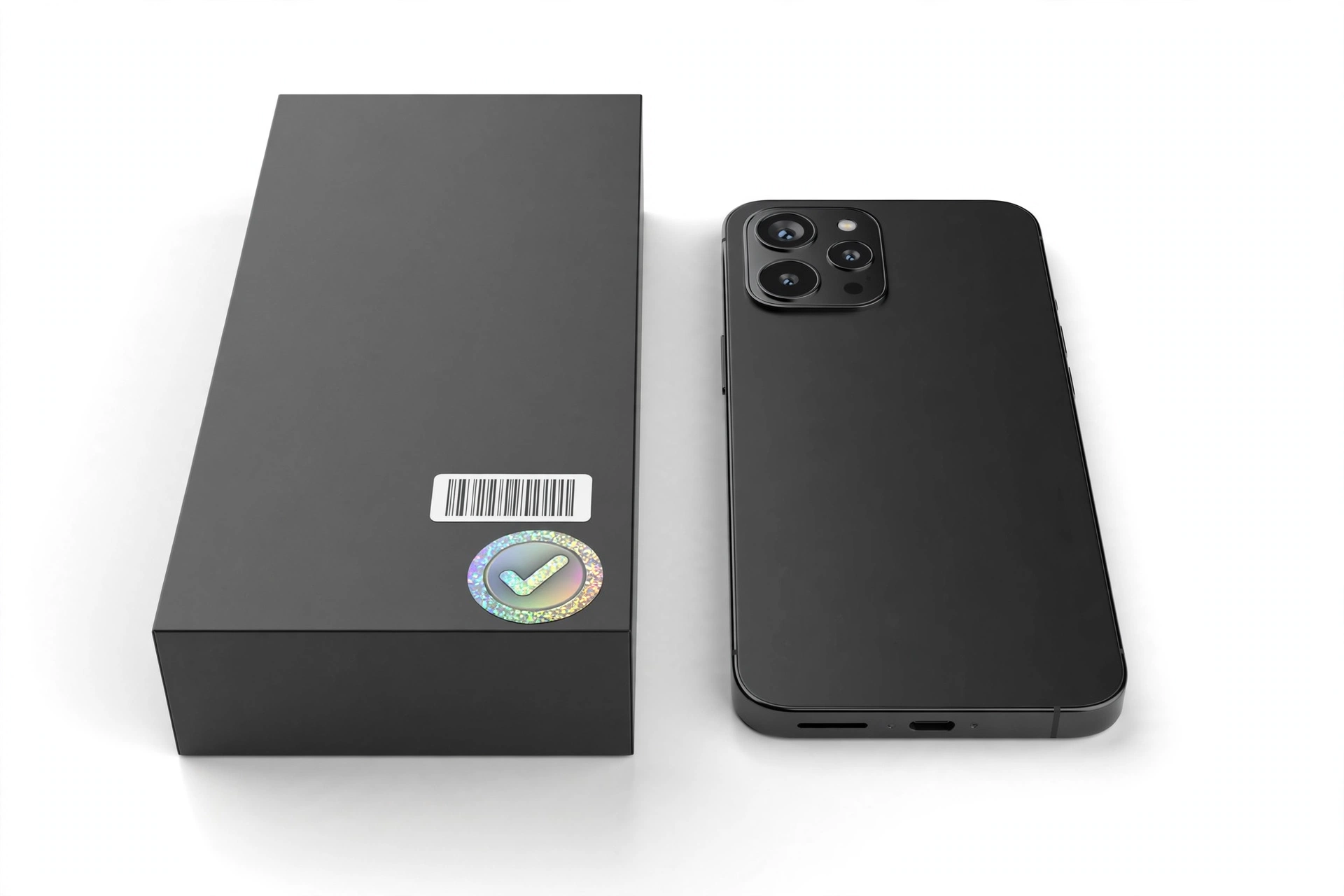
- Box label: the retail box carries a barcode label printed with IMEI, MEID, and serial number (often abbreviated SN).
- SIM tray / eSIM settings: on dual-eSIM models there are two IMEIs (one per eSIM slot), shown in Settings > About phone. Both should follow the same cross-match rule.
The cross-match rule
All three sources must show the identical IMEI and serial. Write them down and compare digit by digit. The outcomes mean different things:
| Result | Meaning | Next step |
|---|---|---|
| Dialer = Settings = box, all match | Consistent identity — passes this check | Continue to the hardware and software checks |
| Dialer and Settings match, box differs | Phone may be genuine but re-boxed, or the box belongs to another unit | Treat as used/refurbished; verify software checks carefully |
| Dialer and Settings differ from each other | Strong counterfeit signal — the software identity was altered | Do not buy; see section 12 |
| IMEI is all zeros, 15 identical digits, or obviously sequential | Invalid IMEI — not a genuine factory-programmed unit | Do not buy; see section 12 |
| Seller refuses to share the IMEI before purchase | Cannot verify — walk away | Find another seller |
Stop for safety: a valid, matching IMEI proves the number is real — it does not prove the phone in your hand is the phone that number belongs to. Copied IMEIs (a real IMEI from a genuine Pixel pasted into a fake’s software) are a known counterfeit technique. That is why the IMEI check is Check 1 of 10, not the whole verdict.
5. Check 2: model-variant sanity — 10 Pro vs. 10 vs. 10 Pro XL
A common deception is not a fully fake phone but a mislabeled one: a base Pixel 10 or a larger Pixel 10 Pro XL sold as a Pixel 10 Pro, sometimes at the Pro’s price. The three models share a family resemblance, so check the distinguishing features:
| Feature | Pixel 10 | Pixel 10 Pro (this guide) | Pixel 10 Pro XL |
|---|---|---|---|
| Display | 6.3-inch OLED | 6.3-inch LTPO OLED | 6.8-inch LTPO OLED |
| RAM | 12 GB | 16 GB | 16 GB |
| Rear cameras | 48 MP main + 13 MP ultrawide + telephoto | 50 MP + 48 MP ultrawide + 48 MP telephoto (5x) | 50 MP + 48 MP ultrawide + 48 MP telephoto (5x) |
| Front camera | Lower resolution | 42 MP | 42 MP |
| Battery | 4,970 mAh | 4,870 mAh | 5,200 mAh |
| Storage options | 128 / 256 GB | 128 / 256 / 512 GB / 1 TB | 256 / 512 GB / 1 TB |
| Starting price | $799 | $999 | $1,199 |
If Settings > About phone reports 12 GB of RAM, the phone is a base Pixel 10 regardless of what the listing title says. If the body is clearly a 6.8-inch device, it is a Pro XL. Both are genuine Google phones — but a seller presenting either as a “Pixel 10 Pro” is misrepresenting the product, and the price should reflect the actual model.
6. Check 3: Tensor G5 and physical hardware tells
Go to Settings > About phone > Model & hardware (or the Android version / processor line) and confirm the chip reads as a Google Tensor variant. On a genuine Pixel 10 Pro this is the Tensor G5 — Google’s first Pixel chip manufactured on TSMC’s 3 nm process, a widely reported break from the Samsung-manufactured Tensor generations. A phone claiming to be a Pixel 10 Pro while reporting a Snapdragon, MediaTek, or older Tensor chip is not genuine.
Physical inspection points that are hard to fake well:
- The camera bar. The Pixel 10 Pro carries the signature full-width horizontal camera bar housing three lenses. It should be a single machined element, flush and symmetrical — not a glued-on strip, not three separate camera bumps.
- Materials and weight. Glass front and back with an aluminum frame, 207 g, 8.6 mm thin. A noticeably light, plasticky, or creaky-feeling phone contradicts the spec sheet.
- USB-C port. The Pixel 10 Pro uses USB-C 3.2 Gen 2. The port should be centered, cleanly cut, and firm — wobbly or off-center ports are a poor-manufacturing tell.
- Qi2 magnetic wireless charging. The Pixel 10 Pro supports Qi2 with magnetic alignment. A genuine unit snaps onto magnetic Qi2 chargers; many fakes charge wirelessly (slowly, misaligned) or not at all.
- No physical SIM tray on US units. Per launch reporting, US Pixel 10 models are eSIM-only. A physical SIM tray on a phone sold as a brand-new US Pixel 10 Pro is a red flag. (International variants may include a nano-SIM slot — judge against the region the seller claims.)
- Display quality. The LTPO OLED should show deep blacks, smooth 1–120 Hz adaptive motion, and high brightness outdoors. A washed-out LCD-look panel with visible backlight bleed is disqualifying.
7. Check 4: Pixel-exclusive software signs
This is the check counterfeits fail most visibly. A fake can copy a spec label, but it cannot easily reproduce Google’s software stack — because that stack is tied to Google’s servers, the Titan M2 security chip, and Play certification.
Tests to run on the phone
- Google Play Store works normally. Open the Play Store, sign in with a Google account, and install an app. Counterfeits often ship with a skinned fake store or fail Play Protect certification. Go to Play Store > profile > Play Protect and confirm certification status.
- Settings > Security & privacy shows genuine Pixel options. Look for the Titan M2-backed security features and a normal Android security patch level dated sensibly (not years old on a “new” phone).
- Pixel-exclusive features are present and working. On a genuine Pixel 10 Pro you should find features like Call Screen, Hold for Me, Magic Cue (the on-device contextual AI assistant), and Camera Coach. A phone missing all of Google’s signature features while claiming the Pixel name is suspicious.
- System update path is Google’s. Go to Settings > System > Software updates and check for updates. A genuine Pixel contacts Google’s update servers and shows the 7-year update promise context. Fakes often show “your system is up to date” permanently on an old patch, or the update screen errors out.
- Bootloader status. On a phone sold as new and sealed, the bootloader should be locked. An unlocked bootloader on a “brand new” unit means it was previously used or modified — treat it as used at best.
- Google Fi / carrier activation. The phone should activate normally on major carriers. Activation failures paired with other red flags strengthen the fake verdict.
Quick fact: the Titan M2 security coprocessor is a physical chip inside genuine Pixels. No software skin can add it. If a security audit app or the Settings security page shows no Titan-class hardware attestation on a phone sold as a Pixel 10 Pro, that is a strong negative signal.
8. Check 5: packaging and box tells
- Box contents: phone + 1 m USB-C to USB-C cable, and nothing else. A charger brick, “free” earbuds, or a stack of bonus accessories in the box contradicts Google’s actual packaging.
- Label quality: the IMEI/MEID/serial label should be sharply printed, perfectly aligned, with barcodes that scan. Blurry printing, crooked labels, or misspelled regulatory text are counterfeit tells.
- Seals: genuine retail seals are clean and tamper-evident. Re-glued flaps, double seals, or shrink-wrap over a damaged box suggest repackaging.
- Regulatory markings: the box and phone should carry correct FCC/CE-style regulatory marks for the claimed region. Absent or generic-looking marks are a warning sign.
9. Check 6: where you bought it — purchase-channel risk table
| Channel | Risk level | Notes |
|---|---|---|
| Google Store (new) | Lowest | Direct from Google; full warranty |
| Major carriers — T-Mobile, AT&T, Verizon (new) | Lowest | Carrier-sourced stock; activation-tied |
| Amazon / Best Buy, sold and shipped by the retailer (new) | Low | Confirm the “sold by” field — marketplace third-party sellers vary |
| Carrier or manufacturer certified refurbished | Low | Genuine hardware, but sold as refurbished — price should reflect it |
| Peer marketplaces (new-in-box claims) | Medium–high | Run every check in this guide before paying; meet return-window rules |
| Social-media / messaging-app sellers, no returns | Highest | Most reported fake-phone purchases happen here; avoid |
A price far below the $999 launch starting point for a supposedly new, sealed unit is itself a signal. Genuine new Pixel 10 Pro units do get discounted over time, but a “brand new” phone at half price with no receipt and no returns is the classic counterfeit setup.
10. Master authenticity worksheet: the 10 checks at a glance
| # | Check | What it proves | Limitations |
|---|---|---|---|
| 1 | Three-source IMEI/serial cross-match | The phone’s identity is internally consistent | A copied real IMEI passes this alone |
| 2 | Spec snapshot comparison (section 3) | The phone matches the documented product | Requires knowing the official specs |
| 3 | Model-variant sanity (10 vs 10 Pro vs 10 Pro XL) | You are getting the model you paid for | Only catches mislabeling, not full fakes |
| 4 | Tensor G5 + hardware tells | The physical hardware matches Google’s design | Needs hands-on inspection |
| 5 | Play Store + Play Protect certification | Google recognizes the device as legitimate | Requires signing in with a Google account |
| 6 | Pixel-exclusive software features | The software stack is genuinely Google’s | Some features need setup and network |
| 7 | System update path | The phone is enrolled in Google’s update system | Needs Wi-Fi and a few minutes |
| 8 | Packaging and box inspection | The retail presentation is factory-original | Re-boxed genuine phones also fail this |
| 9 | Purchase channel + price sanity | The transaction context is legitimate | Good fakes appear on real marketplaces too |
| 10 | Carrier activation test | The IMEI is clean and the radios work | Needs a SIM/eSIM and carrier cooperation |
Score your phone honestly: a genuine Pixel 10 Pro passes all ten. One or two amber results (a re-boxed genuine phone, an international variant) deserve the explanations in this guide. Three or more red results — especially mismatched IMEIs plus wrong chip plus missing Play certification — is a fake verdict.
11. Counterfeit vs. refurbished vs. gray market — know which you have
Not every suspicious phone is a counterfeit. These three categories need different responses:
| Category | What it is | How to recognize it | What to do |
|---|---|---|---|
| Counterfeit | Not made by Google; imitates the design | Fails software checks, wrong chip, no Play certification | Do not buy; report the seller; see section 12 |
| Refurbished (sold as new) | Genuine Google hardware, previously used | Passes software checks; signs of use; unlocked bootloader possible | Negotiate a used-phone price or return it |
| Gray market / import | Genuine Google hardware meant for another region | Passes checks; wrong-region charger/labels; possible band differences | Confirm carrier compatibility before keeping it |
12. What to do if your Pixel 10 Pro is fake
- Stop trusting it with your data. Do not sign into banking, email, or primary Google accounts on a confirmed or strongly suspected fake — its software cannot be trusted.
- Document everything. Photograph the phone, box, labels, listing screenshots, receipts, and the seller’s details before anything is returned or discarded.
- Use the purchase channel’s buyer protection. Marketplaces and payment providers have counterfeit-item dispute processes — file promptly, inside the stated window.
- Report the seller. Report counterfeit listings to the marketplace and, where appropriate, to local consumer-protection authorities.
- Do not resell it as genuine. Passing a known fake to the next buyer repeats the fraud and can create liability. Recycle it through an e-waste program instead.
Stop for safety: never try to “fix” a fake by flashing firmware, unlocking the bootloader, or installing ROMs from forums. These steps can brick the phone, and on a counterfeit they do not make it genuine — they only waste your time and can expose your computer to malware.
13. What your checks can and cannot establish
| Observation | What it establishes | What it does NOT establish |
|---|---|---|
| IMEI matches across three sources | Internal identity consistency | That the IMEI belongs to this physical phone |
| Play Protect certified, updates work | Google’s systems recognize the device | That it was never refurbished or repaired |
| All specs match the official table | The hardware matches the documented product | The phone’s history (theft, blacklisting) |
| Bought from the Google Store | Legitimate retail provenance | That nothing was swapped after purchase |
| Box is sealed and perfect | Factory-style presentation | Genuineness — resealing is a known technique |
14. Hypothetical examples
(The following are hypothetical illustrations, not customer stories.)
Example 1 — Maya’s marketplace “deal.” Maya finds a “brand new sealed” Pixel 10 Pro for $549 on a peer marketplace. Before paying, she asks for the IMEI and a screenshot of Settings > About phone. The seller sends an IMEI but refuses the screenshot and insists on payment by wire transfer. Maya walks away. The refusal to show basic verification screens plus a price far below launch pricing and a no-protection payment method are three independent red flags — no single check was even needed.
Example 2 — Daniel’s too-good Pixel. Daniel buys a Pixel 10 Pro from a social-media seller. The phone looks right and the IMEI matches the box. But the Play Store will not sign in, Settings shows 8 GB of RAM, and there is no sign of Call Screen or any Pixel-exclusive feature. The matching IMEI was copied from a real Pixel; the phone itself is a counterfeit. Daniel documents everything and files a payment dispute within the protection window.
15. Frequently asked questions
Can I check Pixel 10 Pro authenticity with just the IMEI online?
Not conclusively. Google offers no public “genuine or fake” IMEI portal. IMEI lookups can confirm the number’s format, blacklist status, and sometimes the registered model — useful supporting evidence — but a copied real IMEI defeats any lookup. Combine the IMEI cross-match with the hardware and software checks in this guide.
Where do I find the Pixel 10 Pro’s IMEI?
Dial *#06#, or go to Settings > About phone > IMEI, or read the barcode label on the retail box. On dual-eSIM models you will see two IMEIs (one per eSIM slot); both should cross-match with the box label.
Does the Pixel 10 Pro have a physical SIM tray?
Per launch reporting, US models are eSIM-only with no physical SIM tray (dual eSIM). International variants may include a nano-SIM slot. A physical tray on a phone sold as a brand-new US unit contradicts the documented configuration and deserves an explanation from the seller.
How can I tell a Pixel 10 Pro from a Pixel 10 Pro XL?
Size is the giveaway: the Pro is 6.3 inches and 207 g; the Pro XL is 6.8 inches and heavier with a 5,200 mAh battery. Check Settings > About phone for the model name and compare against the table in section 5.
What colors does the Pixel 10 Pro come in?
Four: Jade, Moonstone, Obsidian, and Porcelain. Any other color name on the listing or box — or a finish that does not match Google’s official imagery — means the unit is mislabeled or fake.
The phone passes every software check but the box looks re-sealed. Is it genuine?
Probably a genuine phone in non-original packaging — common with refurbished or re-boxed units. Price it as used, not new, and confirm the IMEI is not blacklisted before keeping it.
Should I buy a Pixel 10 Pro from a social-media seller with no returns?
No. That channel carries the highest counterfeit risk and offers no recourse. Use the Google Store, a major carrier, or a reputable retailer — or insist on a marketplace with buyer protection and run every check in this guide inside the return window.
Can a repair shop verify my Pixel 10 Pro for me?
A shop can help with hands-on inspection and running the checks in this guide, but no shop can issue an official Google genuineness certificate — Google does not offer one to third parties. If you are in the Las Vegas area and want an independent second opinion before a purchase or repair, Las Vegas Phone Repair & Accessories (7400 Las Vegas Blvd S, Unit TT42, Las Vegas, NV 89123; (424) 406-6202; open 10 AM–8 PM, call ahead to confirm today’s hours) can assess the device — note that an assessment is an inspection, not a manufacturer certification.
Video: How to tell if your smartphone is fake or real
Sources and editorial notes
- Android Headlines — Google Pixel 10 Pro buyer’s guide: full spec table (Tensor G5, 16 GB RAM, 50/48/48 MP cameras, 42 MP front, 4,870 mAh, colors, $999 launch pricing, August 28 on-sale date).
- Tom’s Guide — Pixel 10 Pro and 10 Pro XL unveiled: launch coverage confirming Tensor G5, Qi2 magnetic charging, camera system, and color lineup.
- TweakTown — Pixel 10 series announced: Tensor G5 on TSMC 3 nm, storage tiers, battery capacities, and launch pricing.
- HardReset.info — how to check IMEI on Google Pixel: the *#06# dialer method and Settings paths for retrieving IMEI and serial.
- iUnlocker — Google Pixel IMEI check guide: what IMEI lookups can reveal (model, warranty/activation data, carrier lock, blacklist status) and their limits.
- Verizon — what to know when buying a used phone: requesting the IMEI before purchase and checking it for theft/lock status.
Last source check: October 14, 2026. AI-assisted editorial guide, checked against the linked manufacturer information and launch reporting summarized above in our own words. Specifications reflect launch reporting and may have been revised by Google since; launch prices are historical. No manufacturer authorization is claimed, and nothing here constitutes an official Google genuineness certification.
Let’s get you connected again.
Tell us what’s happening with your device and we’ll help you decide the safest next step — no jargon, no pressure.
Las Vegas Phone Repair & Accessories · 7400 Las Vegas Blvd S, Unit TT42, Las Vegas, NV 89123
10:00 AM–8:00 PM — call ahead to confirm today’s hours