
How to Check If Google Pixel 11 Pro Is Original: Authenticity Guide
Yes — the Google Pixel 11 Pro is a real phone Google launched in August 2026, so any “Pixel 11 Pro” that fails the checks in this guide is either a counterfeit, a relabeled Pixel 11, or a mislabeled import. Work through the IMEI cross-match, the impossible-configuration filter, and the signature hardware tells below before you pay or sign in.
On this page
Yes — the Google Pixel 11 Pro is a real phone Google launched in August 2026, so any “Pixel 11 Pro” that fails the checks in this guide is either a counterfeit, a relabeled Pixel 11, or a mislabeled import.
1. Who this guide is for — and the one question it answers
This guide answers a single question: is the device in your hand a genuine Google Pixel 11 Pro? It is written for people buying a new or used unit — from a marketplace, a classifieds ad, a trade-in counter, or a friend — and for anyone who already owns one and has started to doubt it. If you are shopping for a repair, a different guide covers Google Pixel repair options. (Source: phonearena.com)
Before we go further, one honesty note: this guide teaches you how to verify the hardware and software against Google’s own reported specifications and documented verification methods. No home check can substitute for an official Google Store warranty lookup, and a passed check does not guarantee the phone is free of repair history, financing locks, or carrier restrictions.
Quick fact: the Pixel 11 Pro is one specific model — a 6.3-inch flagship with a triple rear camera. Sellers who offer a “Pixel 11 Pro Max,” a “Pixel 11 Pro Ultra,” or a “Pixel 11 Pro 5G” are inventing model names; none of those exist in Google’s reported lineup.
2. The existence test: the Pixel 11 Pro is real
Counterfeit guides often begin with an existence test because some “devices” being sold never existed. That is not the case here. According to launch reporting, Google unveiled the Pixel 11 lineup on August 12, 2026 at a Made by Google event in New York, with wide retail availability from August 20, 2026. The family reportedly included the standard Pixel 11, the Pixel 11 Pro, the larger Pixel 11 Pro XL, and a Pixel 11 Pro Fold.
This matters for your check because it changes what a fake looks like. With unreleased phones, fakes are usually entire fabrications. With a launched phone like the Pixel 11 Pro, the common scams are:
- Relabeled siblings — a genuine standard Pixel 11 sold as a Pro (the most common scam, covered in section 8).
- Relabeled predecessors — a Pixel 10 Pro reflashed and sold as an 11 Pro.
- Counterfeits — Android phones with a skin and a fake Settings screen, built to fool a glance.
- Refurbished units sold as new — genuine hardware, dishonest listing.
All launch details in this guide are attributed to launch reporting, not to Google’s own current product pages, and you should treat every specification as “reported” rather than as a promise from Google.
3. The instant-reject filter: ten configurations that cannot be a Pixel 11 Pro
Run this filter first. If any single line matches, stop — the device is not a Pixel 11 Pro, and you do not need the rest of the guide.
| # | Claimed feature | Why it fails |
|---|---|---|
| 1 | Tensor G5, Tensor G4, or any non-Tensor chip | Reported spec is the Google Tensor G6 |
| 2 | 8 GB of RAM | Reported tiers are 12 GB and 16 GB only |
| 3 | 128 GB storage | Reported tiers start at 256 GB (256 GB / 512 GB / 1 TB) |
| 4 | A physical SIM card tray | The Pixel 11 Pro is reported as dual-eSIM only, with no physical SIM slot |
| 5 | microSD card slot | No Pixel 11-series model has expandable storage |
| 6 | Headphone jack | No 3.5 mm jack on the reported device |
| 7 | Two rear cameras | The Pro has three rear cameras; two means a relabeled standard Pixel 11 |
| 8 | A 200 MP camera anywhere in the spec list | Reported cameras are 50 MP + 48 MP + 48 MP rear, 42 MP front — no 200 MP sensor exists in this lineup |
| 9 | MIUI, ColorOS, or any non-Pixel Android skin | A genuine Pixel runs Google’s own Pixel UI on Android 17 |
| 10 | Model names like “Pro Max,” “Pro Ultra,” or “Pro 5G” | Google’s reported lineup uses only “Pro” and “Pro XL” |
Stop for safety: never sign in to your Google account — or enter banking details, passwords, or payment information — on a device you suspect is counterfeit. Some clones run modified software designed to harvest credentials. Verify first, sign in later.
4. Reported spec baseline: what the real phone looks like on paper
Authenticity checking is comparison work, so you need a reliable baseline. The table below summarizes the Pixel 11 Pro’s specifications as reported by launch coverage. Use it as your answer key for every screen and label you inspect.
| Attribute | Reported specification |
|---|---|
| Announcement | August 12, 2026 (Made by Google, New York) |
| Retail availability | August 20, 2026 |
| Display | 6.3-inch LTPO OLED, 1280 × 2856, 1–120 Hz adaptive, up to 3,600 nits peak, Gorilla Glass Victus 2 |
| Chipset | Google Tensor G6 (reported 2 nm-class), Titan M3 security chip |
| RAM / storage | 12 GB / 256 GB, 16 GB / 512 GB, 16 GB / 1 TB; LPDDR5X, UFS 4.0; no expansion |
| Rear cameras | 50 MP main (f/1.68, OIS) + 48 MP ultrawide + 48 MP 5x periscope telephoto; up to 120x Pro Zoom; 8K/30 video |
| Front camera | 42 MP autofocus, f/2.2, 103° field of view |
| Battery / charging | 4,850 mAh; 30 W wired; 25 W Qi2.2 magnetic wireless |
| Software | Android 17 at launch; 7 years of OS, security, and Pixel Drop updates |
| Biometrics | Ultrasonic in-display fingerprint sensor |
| SIM | Dual eSIM (no physical SIM tray reported) |
| Connectivity | 5G, Wi-Fi 7, Bluetooth 6, USB-C 3.2, NFC, IP68 |
| Dimensions / weight | 152.4 × 71.1 × 8.4 mm; 204 g |
| Colors | Canyon, Olive, Fog, Obsidian (matte) |
| Reported starting price | $1,099 (256 GB); ₹1,19,999 in India |
Where launch reports disagree — for example, on the exact nanometer process of the Tensor G6 — this guide says so rather than picking a winner. Disagreement among reporters is itself useful information: it tells you which details are soft.
5. The 10-check master worksheet
Print this mentally and work top to bottom. Each check is detailed in the sections that follow.
| # | Check | What it proves | Limitations |
|---|---|---|---|
| 1 | Instant-reject filter (§3) | Catches obvious fakes in seconds | Passes relabeled siblings and good clones |
| 2 | IMEI/EID retrieval (§6) | Device has real cellular hardware identifiers | Numbers can be cloned; one check is never enough |
| 3 | IMEI/box/Settings cross-match (§7) | The phone, its box, and its software agree | Needs the original box; not available for all used sales |
| 4 | Rear camera count and 5x telephoto test (§8–9) | Catches relabeled standard Pixel 11 units | Needs good lighting and a steady hand |
| 5 | Tensor G6 hardware verification (§9) | Catches reflashed predecessors and clones | Requires a hardware-info app from the Play Store |
| 6 | 42 MP front camera and ultrasonic fingerprint (§9) | Signature hardware only the real Pro carries | Clones sometimes fake these in software |
| 7 | Dual-eSIM / no SIM tray (§9) | Strong physical tell against clones | None significant |
| 8 | Pixel UI and update-server test (§10) | Software is genuine Google firmware | Needs Wi-Fi; some clones spoof the UI |
| 9 | Play Protect certification (§10) | Google certifies the device build | Certification can be revoked later |
| 10 | Google Store warranty lookup (§11) | Google’s own records recognize the serial | Needs the serial number; region-dependent |
6. Check 1: finding the IMEI, EID, and serial number
The IMEI (International Mobile Equipment Identity) is the 15-digit number that identifies the phone’s cellular hardware. The EID identifies the embedded SIM chip, and the serial number identifies the physical device for warranty purposes. Here is how to read them on a Pixel:
- Dialer method: open the Phone app and dial *#06#. The IMEI, EID, and serial number appear on screen.
- Settings method: go to Settings > About phone and look for the IMEI, serial number, and model entries.
- Box method: the barcode label on the back of the retail box lists the IMEI/MEID and serial number.
A genuine Pixel 11 Pro should show the model name as Pixel 11 Pro in Settings > About phone. If the model field is blank, reads “Unknown,” or names a different device, treat that as a strong fake signal — though a blank field can occasionally indicate a software fault, which is why you never rely on one check alone.
Protect your IMEI: your IMEI is a device identifier — do not post it in public listings, forums, or social media, and do not type it into random “free IMEI checker” websites you found through ads. Cloned IMEIs are a real problem: scammers copy real numbers onto counterfeit phones. Use only the verification routes described in this guide.
7. Check 2: the IMEI cross-match
One number proves little; three matching numbers prove a lot. Compare the IMEI across every place it appears:
| What you compare | Match | Mismatch means |
|---|---|---|
| *#06# screen vs. Settings > About phone | Both show the same IMEI | Software tampering — the firmware may be modified |
| *#06# screen vs. box barcode | IMEI identical | The phone is not the one that came in that box — ask why |
| Serial number in Settings vs. box | Serial identical | Same conclusion: box and phone were not paired at the factory |
| IMEI on a carrier or Google record | Record matches the phone | The device identity has been altered or the record belongs to another unit |
A mismatch does not always mean counterfeit — a phone can be genuine but boxed wrongly at a reseller, or its board may have been replaced during a legitimate repair. But it always means you should pause the purchase and get an explanation in writing before money changes hands.
8. The most common scam: a relabeled standard Pixel 11
The standard Pixel 11 and the Pixel 11 Pro share a 6.3-inch screen size, the Tensor G6 chip, and a similar design — which makes the standard model the perfect donor for the most common “fake Pro” scam. A genuine standard Pixel 11, sold at Pro prices, will pass a casual inspection. The table below shows how to tell them apart.
| Feature | Pixel 11 (standard) | Pixel 11 Pro |
|---|---|---|
| Rear cameras | Dual camera (reported) | Triple: 50 MP main + 48 MP ultrawide + 48 MP 5x telephoto |
| Telephoto | None (digital zoom only) | 48 MP periscope, 5x optical, up to 120x Pro Zoom |
| Front camera | Lower-resolution selfie camera (reported) | 42 MP autofocus, 103° field of view |
| Display | LTPS OLED | LTPO OLED, up to 3,600 nits peak |
| RAM | Lower tier (reported) | 12 GB or 16 GB |
| Fingerprint sensor | Optical (reported on standard models) | Ultrasonic in-display |
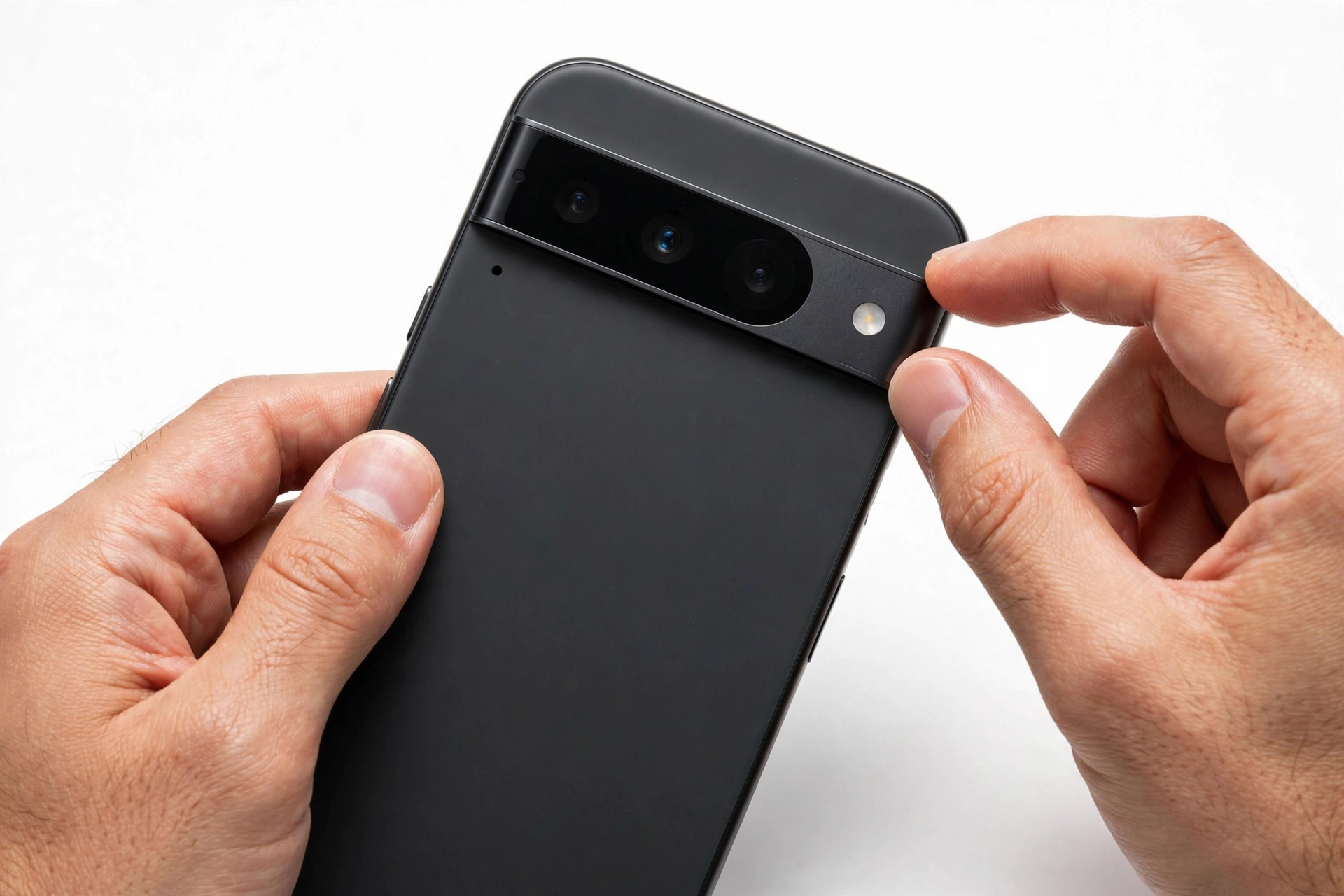
The fastest single test: count the rear camera lenses and open the camera app’s zoom control. A genuine Pro shows a 5x optical telephoto option and zoom detail that holds up at long range. A relabeled standard Pixel 11 has two rear lenses and relies on digital zoom that degrades quickly. If the seller’s “Pro” has two rear cameras, the conversation is over.
9. Signature hardware tells of the Pixel 11 Pro
Beyond the sibling comparison, several hardware features are difficult or expensive for counterfeiters to fake. Test each one.
The 48 MP 5x periscope telephoto
The periscope telephoto is the Pro’s functional lie detector. Cover each rear lens in turn with your finger while the camera app is open: when you cover the telephoto lens, the 5x zoom preview should go dark. Then compare a 5x zoomed photo against a 1x photo cropped to the same framing — genuine optical zoom preserves far more detail. A clone faking the zoom in software will show the characteristic smearing of digital zoom.
The 42 MP front camera
Open the front camera and check the resolution of a captured selfie in the Photos app details. A genuine Pro records 42 MP images with autofocus and a notably wide 103° field of view. Counterfeits typically ship 8–16 MP front sensors with fixed focus.
Ultrasonic in-display fingerprint sensor
The Pro uses an ultrasonic sensor under the display. During setup it should enroll quickly and unlock reliably even with slightly damp fingers — optical sensors, found on cheaper phones and many clones, are slower and fail more often with moisture. This is a supporting tell, not a decisive one, but it adds to the picture.
Dual eSIM with no physical SIM tray
The Pixel 11 Pro is reported as dual-eSIM only. If the phone has a physical SIM card tray, it is not a Pixel 11 Pro. This is one of the strongest physical tells in this guide because it requires no software, no lighting, and no expertise — just a look at the phone’s edges.
Tensor G6 verification
Settings > About phone will name the chip, but that text can be faked by modified firmware. Install a reputable hardware-identifier app from the Google Play Store and read the actual system-on-chip identifier. A genuine 11 Pro reports a Tensor G6; a reflashed Pixel 10 Pro reports a Tensor G5, and a clone reports whatever budget chip it was built with.
Qi2 magnetic wireless charging
The Pro supports 25 W Qi2.2 wireless charging with magnetic alignment. If you have a Qi2 magnetic charger or a magnetic mount, the phone should snap into alignment. Most clones omit the magnets entirely.
The camera bar and HiLight feature
Launch reporting describes a slightly slimmer, all-black camera bar compared with the Pixel 10 Pro, plus a new reported “HiLight” feature — LED lights around the rear camera flash that project customizable patterns when the phone is face-down and indicate Gemini activity. Because HiLight is software-driven, check it in Settings rather than trusting the hardware alone, and remember that this detail comes from launch reporting, not from Google’s own documentation.
Quick fact: the reported colors are Canyon, Olive, Fog, and matte Obsidian. A “Pixel 11 Pro” in a color outside that list — especially a glossy finish when Obsidian is reported as matte — deserves extra scrutiny, though limited editions can always surprise.
10. Pixel UI signs: is the software genuine Google firmware?
Counterfeit Pixels run skinned Android builds that imitate Google’s interface. These tests separate imitation from the real thing.
Android 17 with the update-server test
A genuine Pixel 11 Pro launched on Android 17 and receives updates directly from Google. Go to Settings > System > Software update and check for updates over Wi-Fi. A genuine phone contacts Google’s servers and reports its update status; many clones either error out, show a fake “up to date” screen, or redirect to an unfamiliar update app. This is reportedly the check that clone software fears most, because it requires Google’s server-side cooperation.
Play Protect certification
Open the Play Store, tap your profile icon, go to Settings > About, and look for Play Protect certification. Genuine Pixels are certified by Google; many counterfeits are not. An uncertified device can still run apps, but it fails Google’s own integrity bar — and it may lose access to banking apps and Google Pay.
Pixel-exclusive features
Check for features that ship only on genuine Pixels: Call Screen, Hold for Me, the Recorder app with real-time transcription, and Magic Editor in Google Photos. Clones imitate the launcher but rarely replicate this deeper integration. Their absence is a red flag; their presence is a good sign but not proof on its own.
Seven years of updates
Google promises 7 years of OS, security, and Pixel Drop updates for the Pixel 11 Pro. In Settings > Security, a genuine unit shows a coherent update history. A “new” phone showing an ancient security patch level — or a patch date older than the phone’s reported launch — is suspicious.
11. Packaging and purchase checks
The box
Google’s retail box should carry a barcode label with the IMEI and serial number matching the phone (§7). Check the print quality: genuine Google packaging uses sharp, precisely aligned printing; counterfeits often show fuzzy text, misaligned labels, or spelling errors. Be careful here — packaging alone never proves authenticity, since convincing boxes are cheap to print.
Google Store warranty and repair lookup
Unlike some manufacturers, Google does not operate a public buyer-facing IMEI verification portal — a fact this site’s earlier Pixel guides have documented before. What Google does offer is a warranty and repair lookup tied to your serial number through the Google Store support pages. If you have the serial number, start there; if Google’s records show a different model or no record at all, walk away.
Where you buy matters
| Channel | Risk level | Notes |
|---|---|---|
| Google Store / authorized carrier | Lowest | Direct supply chain; full warranty |
| Major electronics retailer | Low | Authorized stock; keep the receipt |
| Established reseller with returns | Medium | Verify serial on arrival; use the return window |
| Marketplace / classifieds / parking-lot deal | High | Run every check in this guide before paying; never pay first |
12. The five categories: not every “fake” is a counterfeit
When a phone fails your checks, it helps to know what you are actually looking at, because the remedy differs.
| Category | What it is | What to do |
|---|---|---|
| Counterfeit | Non-Google hardware with faked software | Do not buy; report the listing to the marketplace |
| Mislabeled sibling | Genuine Pixel 11 sold as a Pro | Renegotiate to the correct model’s price or walk away |
| Reflashed predecessor | Genuine Pixel 10 Pro with tampered software | Walk away — tampered firmware is a security risk |
| Refurbished sold as new | Genuine Pro with repair history, sold as sealed-new | Demand the true condition and a fair price |
| Gray-market import | Genuine Pro meant for another region | Check band support and warranty coverage for your country before buying |
(The following are hypothetical illustrations, not customer stories.) Amara’s marketplace “deal”: Amara found a “Pixel 11 Pro” for $650 on a classifieds site. It had two rear cameras and a physical SIM tray. Two checks — the camera count and the SIM tray — proved it was neither a Pro nor a Pixel 11 at all, and she walked away before paying. Devon’s gray-market import: Devon bought a sealed “Pixel 11 Pro” from an importer. Every hardware check passed, but Google’s warranty lookup showed a region where he doesn’t live. He kept the phone after confirming his carrier’s bands were supported — a gray-market unit, genuine but with limited warranty recourse.
13. What these checks can and cannot establish
| What a check can establish | What it cannot establish |
|---|---|
| The hardware matches the reported Pro specification | Whether the phone was ever opened or repaired |
| The software is genuine Google firmware | Whether the phone is carrier-locked or financed |
| The IMEI is internally consistent | Whether the IMEI is blacklisted (check with the carrier) |
| The seller’s model claim is accurate | The remaining warranty length (check Google’s records) |
| The device is not an obvious counterfeit | The battery’s health or the phone’s water-exposure history |
14. What to do if the phone fails your checks
- Do not pay, and do not sign in. If you already paid, preserve all messages, receipts, and the listing.
- Document the failures. Photograph the mismatched IMEI screens, the camera count, and the SIM tray.
- Report the listing to the marketplace or platform where it was advertised.
- If you need the phone assessed — for example, to confirm whether a unit you already own is genuine before selling it — a local shop can examine the hardware in person. Las Vegas Phone Repair & Accessories, 7400 Las Vegas Blvd S, Unit TT42, Las Vegas, NV 89123, (424) 406-6202, is open 10 AM–8 PM; call ahead to confirm today’s hours before visiting.
Tip: if you are buying any used Pixel — not just the 11 Pro — the same method works: cross-match the identifiers, count the cameras, and run the update-server test. Our broader Google Pixel authenticity guide and the Pixel 11 authenticity guide cover the brand and the standard model. Comparing flagships across brands? The same verification method is applied to Nothing’s flagship in our Nothing Phone 3 Pro authenticity guide.
15. Frequently asked questions
Can I check a Pixel 11 Pro’s IMEI on Google’s website?
Google does not offer a public buyer-facing IMEI checker the way some manufacturers do. You can look up warranty and repair status with your serial number through Google Store support, and carriers can check blacklist status. Do not trust third-party sites that claim to be “Google’s official IMEI checker.”
Does a matching IMEI prove the phone is genuine?
No. IMEIs can be cloned — copied from a real phone onto a counterfeit. A matching IMEI is a good sign, but only the full set of checks (hardware tells, software tests, identifier cross-match) builds real confidence.
How can I tell a Pixel 11 Pro from a Pixel 11 Pro XL?
Size: the Pro is 6.3 inches and the Pro XL is 6.8 inches. Check the display size and the overall dimensions (the Pro is about 152.4 mm tall). A seller offering a “Pro” that is clearly XL-sized is mislabeling the model.
What if the phone has a physical SIM tray?
Then it is not a Pixel 11 Pro. The Pro is reported as dual-eSIM only. This is one of the fastest disqualifiers in the guide.
Can a Pixel 11 Pro have 128 GB of storage?
No. Reported storage tiers are 256 GB, 512 GB, and 1 TB. A “Pro” showing 128 GB in Settings is either a different phone or running faked firmware.
Is the Pixel 11 Pro’s camera bar a reliable visual tell?
It helps — launch reporting describes a slimmer, all-black camera bar — but casings are the easiest thing to copy. Always combine the visual check with the functional camera tests in section 9.
Should I buy a Pixel 11 Pro from an overseas seller?
Gray-market units are usually genuine hardware, but warranty coverage follows the region of sale, and some network bands differ by region. Confirm band compatibility with your carrier and accept the warranty limitation before buying.
What should I do before selling my own Pixel 11 Pro?
Run the same checks a buyer would: confirm the identifiers match, remove your Google account, and perform a factory reset only after your data is backed up. A phone that passes this guide’s checks sells faster and with fewer disputes.
Video: How to tell if your smartphone is fake or real
Sources and editorial notes
- PhoneArena — Google Pixel 11 Pro full specifications: reported spec baseline (Tensor G6, 6.3-inch display, camera details, pricing). Last checked October 14, 2026.
- PhoneArena — Pixel 11 Pro release date, price, specs: August 12, 2026 announcement, August 20 retail availability, Made by Google NYC event. Last checked October 14, 2026.
- Digit.in — Google Pixel 11 Pro confirmed features: Tensor G6, Titan M3, triple camera, 4,850 mAh, Android 17, India pricing. Last checked October 14, 2026.
- Gadgets360 — Pixel 11 series India launch: HiLight feature, camera specifications, dimensions, battery details. Last checked October 14, 2026.
- ManilaShaker — Pixel 11 Pro, Pro XL now official: display, camera, battery, color, and connectivity summary. Last checked October 14, 2026.
- HardReset.info — Google Pixel IMEI check methods: *#06# dialer method and Settings paths for IMEI and serial number. Last checked October 14, 2026.
- SolveYourTech — IMEI, EID, and serial number on Pixel: which identifier to use for carriers vs. warranty, mismatch troubleshooting. Last checked October 14, 2026.
Last source check: October 14, 2026. AI-assisted editorial guide, checked against the linked manufacturer and press information. Launch specifications are attributed to press reporting and may be revised by Google; verification methods reflect publicly documented procedures.
Let’s get you connected again.
Tell us what’s happening with your device and we’ll help you decide the safest next step — no jargon, no pressure.
Las Vegas Phone Repair & Accessories · 7400 Las Vegas Blvd S, Unit TT42, Las Vegas, NV 89123
10:00 AM–8:00 PM — call ahead to confirm today’s hours
1 thought on “How to Check If Google Pixel 11 Pro Is Original: Authenticity Guide”