
How to Check If Vivo X300 Pro Is Original: Authenticity Guide
Yes — the Vivo X300 Pro is a real, launched flagship phone (announced October 13, 2025, on sale in China from October 17, 2025), and a genuine unit carries a MediaTek Dimensity 9500 chip, a 200MP periscope telephoto camera, and OriginOS 6 software. This guide walks you through ten practical checks — from the IMEI triple-match to Vivo’s official warranty lookup to a hands-on telephoto lens test — so you can tell a real X300 Pro from a counterfeit before you hand over money.
On this page
Yes — the Vivo X300 Pro is a real, launched flagship phone (announced October 13, 2025, on sale in China from October 17, 2025), and a genuine unit carries a MediaTek Dimensity 9500 chip, a 200MP periscope telephoto camera, and OriginOS 6 software.
1. Who this guide helps
This guide is written for anyone buying, selling, or already holding a phone that is being called a Vivo X300 Pro. That includes marketplace shoppers comparing private listings, travelers considering a gray-market import, and gift recipients who want to know what they actually have. It is an X300 Pro-specific guide: every check is calibrated to this model’s reported specifications and its Zeiss camera system, not to Vivo phones in general. (Source: en.wikipedia.org)
Quick fact: The X300 Pro launched in China in October 2025 and has since launched in India, Europe, South Africa, and other markets. As of early 2026, no official US launch had been reported — so a unit offered in the United States is almost certainly an import, which is a different situation from a counterfeit (see Section 12).
If you need the brand-level background first, read our guide to checking whether any Vivo phone is original. For other flagship authenticity checks in the same series, see checking the Honor Magic 8 Pro and checking the Realme GT 8.
2. The quick answer: is the Vivo X300 Pro real?
Yes. The Vivo X300 Pro was announced on October 13, 2025 and released in China on October 17, 2025, as the larger sibling of the standard Vivo X300. Press coverage from GizmoChina, Digit, Techloy, and the device’s Wikipedia entry all describe the same phone: a 6.78-inch flagship powered by the MediaTek Dimensity 9500, with a Zeiss co-engineered triple camera headlined by a 200MP periscope telephoto lens.
Because the phone is real, counterfeiters and mislabeled listings have had over a year to appear. The remaining sections give you the checks that actually separate a genuine X300 Pro from a fake — starting with the fastest one.
3. The reported X300 Pro spec baseline
Before checking anything, you need a baseline. The specifications below are drawn from launch reporting (China launch, India launch, and European listings). They are what a genuine X300 Pro should match. Any unit that differs on several of these points deserves deep suspicion.
| Item | Reported specification |
|---|---|
| Chipset | MediaTek Dimensity 9500 (3 nm) |
| Display | 6.78-inch LTPO OLED, 1260 × 2800, adaptive 1–120 Hz, HDR10+ / Dolby Vision, Armor Glass |
| RAM | 12 GB or 16 GB LPDDR5X |
| Storage | 256 GB, 512 GB, or 1 TB UFS 4.1 (India sold as 16 GB + 512 GB only) |
| Rear cameras | 50 MP Sony LYT-828 main (OIS) + 50 MP Samsung JN1 ultra-wide + 200 MP Samsung HPB periscope telephoto (85 mm, ~3.5× optical, OIS), Zeiss optics |
| Front camera | 50 MP Samsung JN1 |
| Battery | 6,510 mAh (China / India / most regions); 5,440 mAh (Europe) |
| Charging | 90 W wired, 40 W wireless, reverse wireless |
| Software | OriginOS 6 based on Android 16 |
| Build | 226 g; 161.98 × 75.48 × 7.99 mm; IP68 / IP69 |
| Biometrics | Ultrasonic under-display fingerprint sensor |
| Colors (reported) | Freedom Blue, Simple White, Pure Black, Wilderness Brown / Dune Brown, Phantom Black |
| Model number | V2502A (China listing) |
| Launch pricing | From CNY 5,299 (12 GB + 256 GB); India ₹1,09,998 (16 GB + 512 GB); Europe €1,399 (16 GB + 512 GB) |
| Update promise | 5 years of OS upgrades, 7 years of security updates (reported for Kenya listing) |
Tip: The Europe battery difference (5,440 mAh vs. 6,510 mAh) is a documented regional variation, not a fake signal. Check the unit’s stated region before judging it on battery capacity — more on this in Section 12.
4. The 30-second impossible-configuration filter
Counterfeit phones fail on configurations that were never part of the X300 Pro lineup. Run this filter first — it catches most fakes in seconds.
- Any chip other than the MediaTek Dimensity 9500. A “Snapdragon,” “Exynos,” or “Helio” chip inside a supposed X300 Pro is a hard fail.
- 8 GB of RAM or 128 GB of storage. Reported configurations start at 12 GB / 256 GB. These tiers do not exist on the X300 Pro.
- A microSD card slot. The X300 Pro does not support expandable storage.
- A headphone jack. None is reported on the X300 Pro.
- A display other than 6.78 inches. A smaller or larger screen means a different phone wearing the name.
- No wireless charging. Genuine units support 40 W wireless charging.
- Anything other than three rear cameras. The X300 Pro has exactly three rear lenses; a two-lens or four-lens back is wrong.
- No periscope telephoto. The 200 MP periscope is the model’s signature. Its absence is disqualifying.
If a listing survives this filter, keep going — a good fake can pass a spec sheet. The checks that follow are harder to cheat.
5. Check 1: the IMEI triple-match
The IMEI is a 15-digit identifier unique to your phone’s radio hardware. On a genuine X300 Pro, the same IMEI appears in three places: the dialer, the Settings app, and the retail box. On many fakes, the numbers do not agree — or the dialer shows nothing at all.
How to read the IMEI
- Open the Phone app and dial *#06#. The IMEI number (or numbers, on dual-SIM units) should appear on screen.
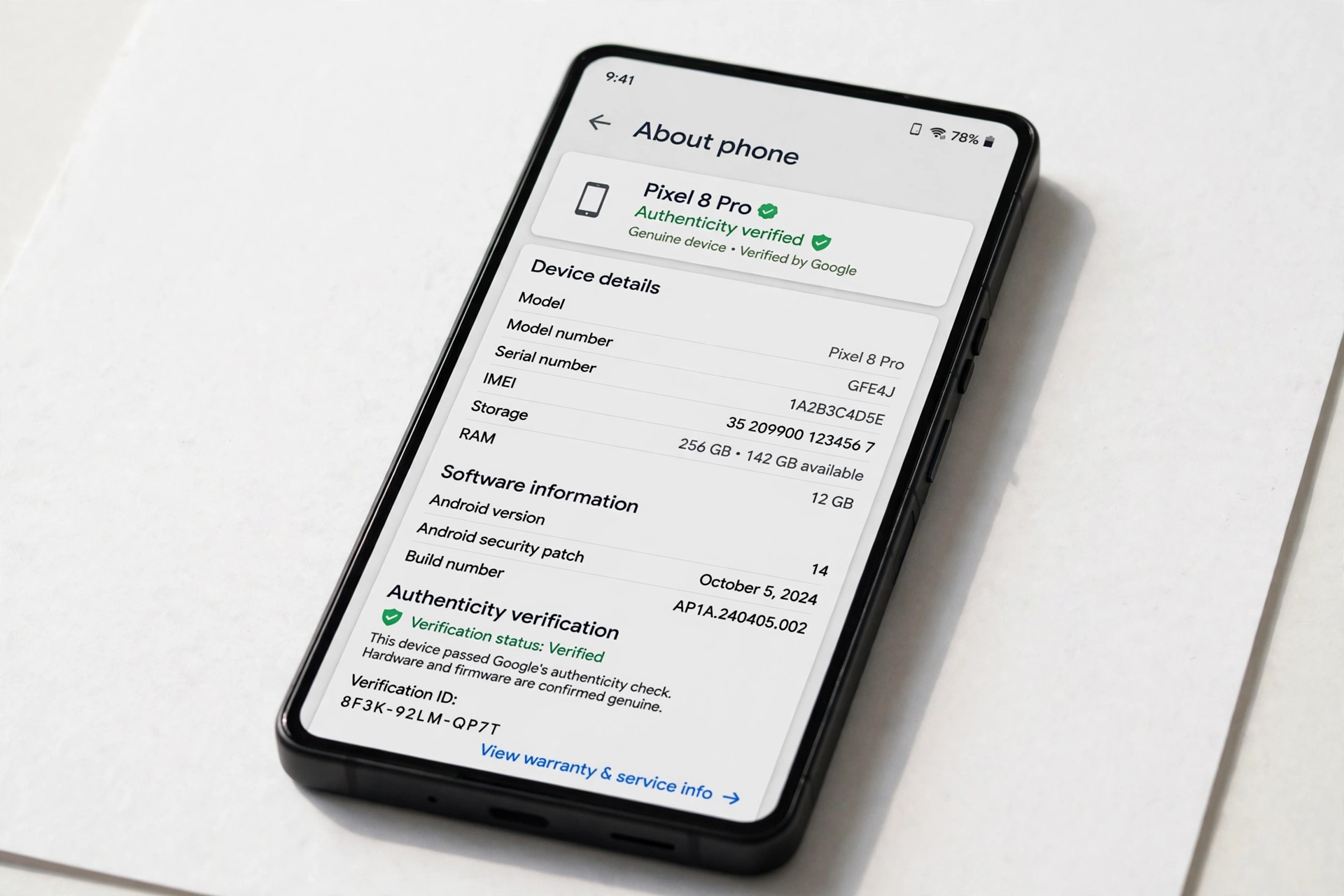
- Alternatively, go to Settings > About phone > Status (on OriginOS the path may read Settings > More settings > About phone) and find the IMEI listed there.
- Compare both against the sticker on the original box.
| Result | Interpretation |
|---|---|
| All three match | Passes this check. The number is at least consistent — continue with the other checks. |
| Dialer and Settings disagree | Hard fail. Genuine firmware pulls the IMEI from the same hardware identity. |
| Neither matches the box | Hard fail. The box belongs to a different phone (or to no real phone at all). |
| *#06# shows nothing | Hard fail on this check. A working X300 Pro always displays its IMEI this way. |
Stop for safety: A matching IMEI proves the number, not the phone. Stolen or cloned IMEI numbers can be written onto fake devices. The IMEI match is necessary but not sufficient — always continue to the software and camera checks below.
6. Check 2: Vivo’s official warranty and IMEI lookup
Vivo operates regional official IMEI and warranty-check pages on its support sites. Multiple independent guides describe the same process: visit the Vivo support site for your region, find the warranty-status or IMEI-check tool, enter the IMEI, and submit. A genuine device returns the model name, color, and warranty details. A counterfeit or unregistered device returns no result.
How to use it
- Get the IMEI using *#06# (see Section 5).
- Visit the official Vivo support website for your region and locate the “Warranty Status Check” or “IMEI Authentication” tool.
- Enter the 15-digit IMEI, complete any verification step, and submit.
- Compare the returned model name, color, and storage against the phone in your hand.
What the result tells you — and what it does not:
- Returns X300 Pro with matching color and memory: strong genuine signal.
- Returns a different Vivo model: the phone may be genuine hardware relabeled as an X300 Pro — a mislabeled-model case (Section 12).
- Returns nothing: treat the phone as suspect. Do not buy it without a conclusive explanation.
- Warranty start date is implausible (for example, activation years before the model’s October 2025 launch): the IMEI likely came from another device.
7. Check 3: OriginOS software tells
Counterfeit hardware can copy a spec sheet, but it rarely reproduces a manufacturer’s full software stack. A genuine X300 Pro runs OriginOS 6 based on Android 16, with Vivo’s services reachable from the phone.
- Settings > About phone should show OriginOS 6 and Android 16. An “Android 12” or “Android 13” build on a supposed 2025 flagship is a fail.
- Software update check: Settings > System update should reach Vivo’s servers. Fakes often error out or show a generic “up to date” that never changes.
- Vivo’s own apps and account: the phone should support signing in to a Vivo account and running Vivo’s system apps (app store, theme store, iManager-style device care). A “Vivo” phone that cannot touch Vivo’s services is not a Vivo.
- Play Protect certification: open the Play Store, tap the profile icon, and check Play Protect certification. Uncertified devices are a strong fake signal.
- Zeiss camera branding inside the camera app: the stock camera app on a genuine X300 Pro carries Zeiss co-branding and Zeiss-style shooting modes. A generic camera app with no Zeiss presence is suspicious.
Quick fact: Vivo’s fourth-generation Zeiss imaging system, including the dual V3+ and VS1 imaging chips, is a hardware-plus-software package. Fakes may print “Zeiss” on the camera island while running a stock Android camera app — the software is the tell.
8. Check 4: the 200MP periscope telephoto test
The periscope telephoto is the X300 Pro’s signature hardware — and the hardest part for a counterfeiter to fake. Use it as a lie detector.
The lens-cover test
- Open the stock camera app and switch to the telephoto zoom level (the ~3.5× option).
- Cover each rear lens in turn with a fingertip while watching the viewfinder.
- At the telephoto zoom, covering the periscope lens should darken the viewfinder. Covering the main or ultra-wide lens should have little effect.
- Repeat at 1× (main lens should respond) and 0.6× (ultra-wide should respond).
If covering a lens does nothing at any zoom, that lens is decorative — a classic fake tell. If the zoom levels look identical (no real optical difference between 1× and 3.5×), the “telephoto” is software trickery.
The zoom-detail test
Photograph the same distant subject — a sign, a license plate, a building edge — at 1× and at full telephoto zoom, then pinch to compare. A genuine 200MP periscope with optical zoom and OIS keeps edges crisp at 3.5×. A fake relying on digital zoom turns the same subject into mush.
The stabilization check
Record a short handheld video at the telephoto zoom while walking slowly. The X300 Pro’s telephoto is reported to carry CIPA 5.5-level stabilization. Excessive judder at 3.5× that disappears at 1× points to a missing periscope module.
Hypothetical example: (The following is a hypothetical illustration, not a customer story.) Imagine a buyer named Sam meets a seller in a parking lot. At 3.5× zoom, covering the middle lens darkens the viewfinder, the zoomed photo of a distant sign stays crisp, and the stabilization looks smooth. All three results point the same way — the periscope hardware is really there.
9. Check 5: physical build and packaging
- Weight and feel: the X300 Pro is reported at 226 g. A unit that feels conspicuously light or hollow is suspicious.
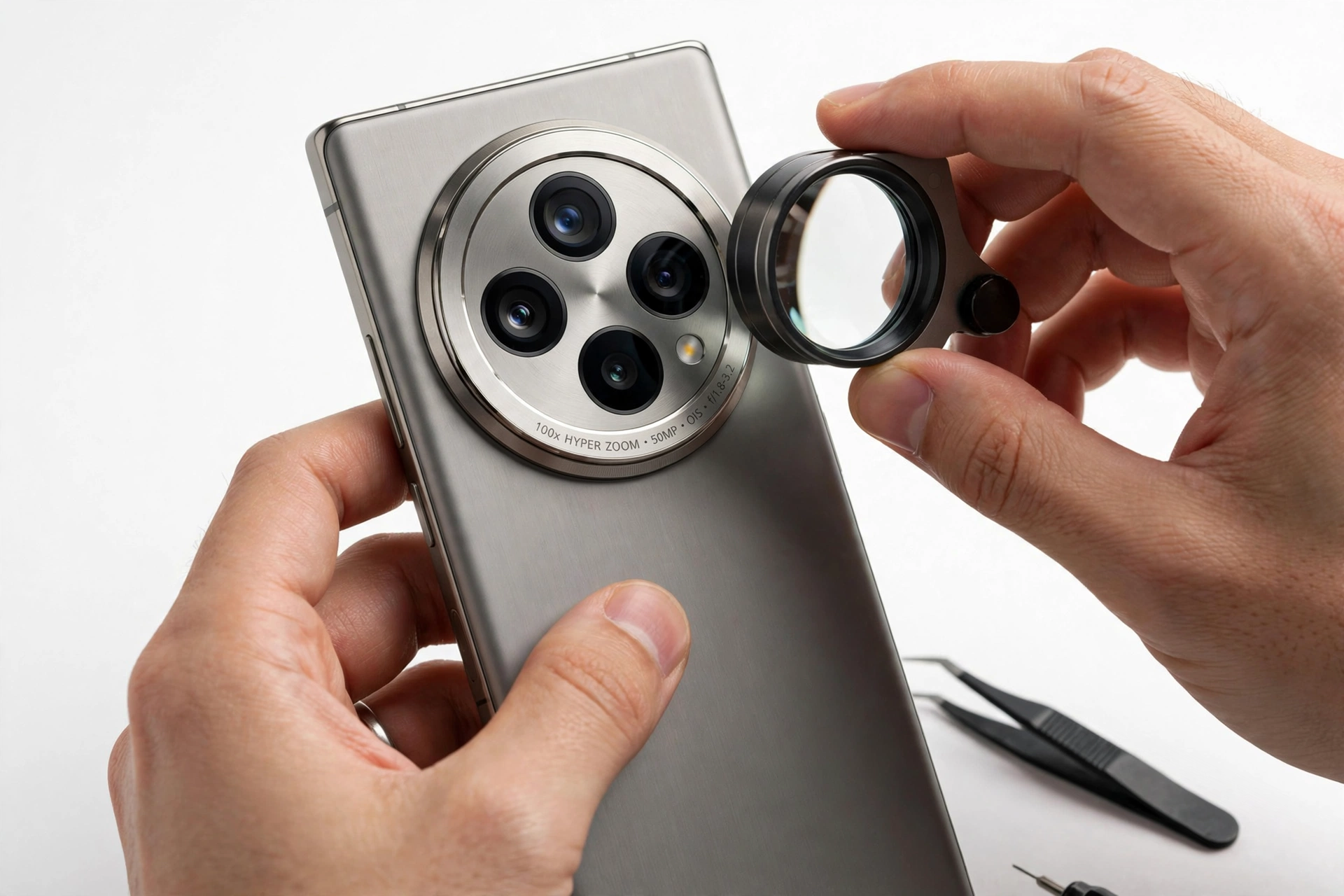
- Camera island: both X300 models use a large circular camera module centered on the back panel, with Zeiss branding. Off-center, misshapen, or unbranded modules are red flags.
- Buttons: launch reporting notes the power and volume buttons sit on the left side, with the Pro adding one extra button on the right. A mirrored button layout suggests a different phone.
- Build quality: look for uneven seams, loose buttons, misaligned ports, and a fingerprint sensor that does not work. The genuine unit uses an ultrasonic under-display sensor; an optical-only or non-working sensor is a fail.
- Box contents: check that the box lists the correct model (V2502A on China units), color, and memory, and that the box IMEI matches the phone. Thin cardboard, spelling errors, or a charger that looks nothing like Vivo’s 90W brick all warrant caution.
- No charger assumptions: verify against the regional retail configuration rather than assuming a charger must be included.
10. Check 6: the 10-check master worksheet
Use this worksheet to score a unit. Every “fail” should make you walk away unless you have a verified explanation.
| # | Check | What it proves | Limitation |
|---|---|---|---|
| 1 | Impossible-configuration filter (Section 4) | Catches crude fakes instantly | Good fakes pass it |
| 2 | IMEI triple-match (Section 5) | Hardware identity consistency | IMEIs can be cloned |
| 3 | Vivo official IMEI/warranty lookup (Section 6) | Vivo recognizes the unit | Regional site availability varies |
| 4 | OriginOS 6 + Android 16 in About phone | Correct software generation | Build text can be spoofed |
| 5 | System update reaches Vivo servers | Real Vivo service relationship | Needs network access |
| 6 | Periscope lens-cover test (Section 8) | Real telephoto hardware | Requires hands-on access |
| 7 | Zoom-detail comparison at 3.5× | Optical vs. digital zoom | Subjective without a reference |
| 8 | Play Protect certification | Google-certified build | Some genuine imports show quirks |
| 9 | Zeiss branding inside the camera app | Real Vivo–Zeiss software stack | Minor regional UI differences |
| 10 | Purchase-channel risk review (Section 11) | Contextual fraud probability | Honest sellers exist everywhere |
11. Where you buy matters: purchase-channel risk
| Channel | Risk level | Notes |
|---|---|---|
| Vivo official store / authorized dealer | Lowest | Full warranty, return rights, genuine stock. |
| Major carrier or electronics retailer | Low | Verify the seller is the retailer itself, not a marketplace storefront inside it. |
| Established online marketplace, sold by the platform | Medium | Platform guarantees help, but third-party sellers on the same site vary widely. |
| Private classifieds / social media | High | Run all ten checks in person before paying; never pay in advance. |
| Price far below market | Very high | A “new” X300 Pro at half the reported launch price is the classic counterfeit signal. |
Tip: Vivo itself has warned buyers (via regional offices) about counterfeit phones sold through unofficial channels, urging purchases from concept stores and authorized dealers. A seller who discourages any verification check is telling you everything you need to know.
12. Not every “fake” is a counterfeit: five categories
People use the word “fake” for five different situations. They need different responses.
| Category | What it is | What to do |
|---|---|---|
| Counterfeit | Non-Vivo hardware dressed as an X300 Pro | Do not buy; report the listing. Do not resell it as genuine. |
| Mislabeled model | A genuine Vivo phone (e.g., a standard X300, or another series) sold as the Pro | The IMEI lookup (Section 6) reveals the true model; renegotiate or walk away. |
| Refurbished sold as new | Genuine X300 Pro with replaced parts, sold as brand new | Check the warranty activation date — a long-ago activation on a “new” phone is the tell. |
| Gray-market import | Genuine X300 Pro meant for another region (no local warranty) | Legitimate hardware, but confirm the regional battery spec and accept the warranty trade-off. |
| Demo / review unit | Genuine hardware, sometimes marked “not for sale” | May lack warranty; buy only at a steep, honest discount. |
The Europe battery difference belongs here too: a European X300 Pro reporting 5,440 mAh is a documented regional variant, not a counterfeit. Judge the battery against the unit’s stated region, not against the China figure.
Hypothetical example: (The following is a hypothetical illustration, not a customer story.) Imagine a traveler named Priya buys an X300 Pro from a reputable importer. The IMEI lookup returns a genuine European unit with matching specs, but the battery reads 5,440 mAh instead of 6,510 mAh. That is the documented European variant — a gray-market import with no local warranty, not a counterfeit. She keeps it, knowing warranty service would require shipping it back to the region of sale.
13. What to do if the phone is fake
- Do not complete the purchase. If you already paid, stop using the phone for anything sensitive.
- Never sign in with your primary Google or Vivo account on a suspected fake. Counterfeit firmware can harvest credentials. (This is a safety stop, not a suggestion.)
- Report the listing to the marketplace and, where available, to Vivo’s regional support.
- Do not resell a known counterfeit as genuine — that passes the harm to the next buyer.
- If you need a working phone assessed or data moved to a replacement, a local repair shop can help with the hardware side. Las Vegas Phone Repair & Accessories, 7400 Las Vegas Blvd S, Unit TT42, Las Vegas, NV 89123, (424) 406-6202 — open 10 AM–8 PM; call ahead to confirm today’s hours.
14. What to do if the phone is genuine
- Register the warranty with Vivo using the IMEI, and keep the box and receipt — they are your proof of authenticity for resale.
- Check for the latest OriginOS 6 update before judging battery life or camera behavior; early software builds are rarely the final word.
- Back up the phone before it ever needs repair — our broken-Vivo data transfer guide exists for the day the screen does not survive a drop.
15. Frequently asked questions
Does Vivo have an official authenticity checker?
Vivo’s regional support sites offer IMEI and warranty-status lookup tools, and independent guides describe entering the IMEI to retrieve the model, color, and warranty dates. Availability varies by region, so use your region’s official Vivo support site rather than a random third-party page.
Can I verify an X300 Pro without the box?
Yes — the dialer (*#06#) and Settings > About phone give you the IMEI without the box, and the software and camera checks need no box at all. The box is a bonus cross-check, not a requirement.
The seller says it’s a US version. Is that possible?
No official US launch for the X300 Pro had been reported as of early 2026. A unit sold in the US is an import — check its regional identity (battery capacity is one clue) and treat “US version” claims with skepticism.
How much should a genuine X300 Pro cost?
Reported launch pricing started at CNY 5,299 for 12 GB + 256 GB in China, ₹1,09,998 for the 16 GB + 512 GB India configuration, and €1,399 for 16 GB + 512 GB in Europe. A “new” unit far below these levels is a strong counterfeit signal; normal used-market depreciation is a different, legitimate thing.
Can a software update turn my genuine X300 Pro into a “fake” reading?
No. A software update cannot change the IMEI, the camera hardware, or Vivo’s record of the device. If a phone fails these checks after an update, it was failing them before — or the update itself is not a genuine Vivo build, which is itself a red flag.
Is the X300 the same as the X300 Pro for authenticity checks?
No. The standard X300 is a smaller phone (6.31-inch display, 6,040 mAh battery) with the 200 MP sensor as its main camera rather than its telephoto. Use the Pro-specific checks here; a standard X300 sold as a Pro is a mislabeled-model case.
What if the IMEI lookup returns a different Vivo model?
Then you likely have genuine Vivo hardware with the wrong name on the listing — the mislabeled-model category from Section 12. Decide whether the actual model is worth the asking price, or walk away.
Should I buy a gray-market X300 Pro?
That is a judgment call, not an authenticity verdict. Gray-market units are genuine hardware without local warranty, and regional differences (like the European battery) apply. Buy only from a seller who states the region openly, at a price that reflects the missing warranty.
Video: How to tell if your smartphone is fake or real
Sources and editorial notes
- Wikipedia — Vivo X300 Pro: announced October 13, 2025, released October 17, 2025; 6.78-inch LTPO OLED 1260×2800; Dimensity 9500; 12/16 GB RAM, 256 GB–1 TB storage; 50 MP LYT-828 main + 50 MP JN1 ultra-wide + 200 MP HPB periscope; 6,510 mAh; IP68/IP69; ultrasonic fingerprint.
- GizmoChina — Vivo X300 & X300 Pro launched in India: Dimensity 9500, 16 GB + 512 GB India configuration, 50 MP LYT-828 main with OIS, 200 MP HPB telephoto at 85 mm with 3.7× optical zoom, dual V3+ and VS1 imaging chips, 6,510 mAh with 90 W wired and 40 W wireless, OriginOS 6 on Android 16, 5 years OS + 7 years security updates.
- Digit — Vivo X300 Pro India pricing and specs: Rs 1,19,999 official India price, 200 MP HPB telephoto with 3.5× optical zoom and f/2.67, 50 MP front camera.
- Tech-Ish — Vivo X300 Pro vs X500 series comparison: launch timeline (China Oct 13, 2025; Europe Oct 30, 2025; Kenya Dec 19, 2025), European 5,440 mAh battery variant, CNY 5,299 launch price, EUR 1,399 Europe price.
- VCGamers — how to check Vivo warranty via official site: Vivo regional support IMEI and warranty-check process described from independent reporting.
- Dr.Fone — Vivo warranty check online guide: Vivo Global IMEI page authenticates brand, model, and specifications from the IMEI; independent guide.
- SoyaCincau — Vivo Malaysia counterfeit warning and IMEI checker: Vivo’s regional anti-counterfeit guidance; genuine units return model, color, and warranty expiry from the IMEI checker; fakes return nothing.
Last source check: October 14, 2026. AI-assisted editorial guide, checked against the linked manufacturer information and launch reporting. Specifications attributed to launch coverage are reported, not manufacturer-confirmed for every market; regional variants (notably the European battery) are noted where documented. Authenticity procedures follow Vivo’s documented IMEI and warranty-check process; no manufacturer authorization is claimed.
Let’s get you connected again.
Tell us what’s happening with your device and we’ll help you decide the safest next step — no jargon, no pressure.
Las Vegas Phone Repair & Accessories · 7400 Las Vegas Blvd S, Unit TT42, Las Vegas, NV 89123
10:00 AM–8:00 PM — call ahead to confirm today’s hours